Original schedule research
London–New York Forex Overlap: 2026 Study
A reproducible calendar analysis of how daylight-saving changes affect the London–New York reference-session overlap, with downloadable data and explicit assumptions.
The result: 20 longer-overlap weekdays
Under the session convention used by our clock, London runs from 08:00 to 16:00 local time and New York from 08:00 to 17:00 local time. Of the 261 Monday–Friday dates in 2026, 20 have a four-hour overlap and the other 241 have a three-hour overlap.
The four-hour periods are 9–27 March and 26–30 October. They arise because the US and UK change their clocks on different dates. This result counts weekdays, not verified trading days: public holidays remain included.
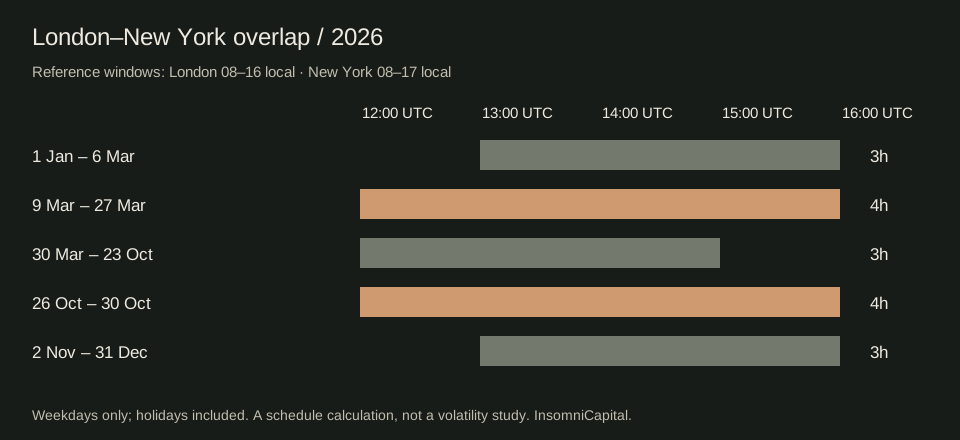
Every 2026 overlap period
| 2026 dates | Overlap (UTC) | Hours | Weekdays |
|---|---|---|---|
| 1 Jan–6 Mar | 13:00–16:00 | 3 | 47 |
| 9 Mar–27 Mar | 12:00–16:00 | 4 | 15 |
| 30 Mar–23 Oct | 12:00–15:00 | 3 | 150 |
| 26 Oct–30 Oct | 12:00–16:00 | 4 | 5 |
| 2 Nov–31 Dec | 13:00–16:00 | 3 | 44 |
Use the live session clock to translate reference windows into your preferred time zone.
Method and reproducibility
- Enumerate all calendar dates in 2026 and retain Monday–Friday.
- Resolve London 08:00 and 16:00 through
Europe/London, and New York 08:00 and 17:00 throughAmerica/New_York, using the runtime’s named-timezone rules. - Take the later opening instant and the earlier closing instant. Their difference is the overlap duration.
- Group consecutive weekday observations with identical UTC start and end times.
- Check the transition dates against the official UK and US sources below and test dates immediately before and after each change.
The dataset was generated on 2 October 2026. Dates later in the year are calculated schedule projections under the current rules, not observed market activity. No market prices, trading volumes or customer records are used.
Download all 261 weekday observations (CSV) · Download data and assumptions (JSON) · Open the original chart
To reproduce the calculation, run node scripts/generate-research.mjs in the published source repository. The calculation is timezone-dependent; record your runtime and timezone-data versions when reproducing it.
What this does not establish
A longer overlap does not establish greater liquidity, lower spreads, higher volatility or a profitable trading opportunity. Testing those questions requires suitable market data and a separate method. Different providers use different reference-session boundaries; using a later London close would change these results.
The study does not model holidays, broker maintenance, instrument-specific hours, or account eligibility. It is not a gold CFD dealing calendar or a trading recommendation.
Sources and attribution
- GOV.UK: UK clock changes on 29 March and 25 October 2026.
- NIST: US daylight-saving period, 8 March–1 November 2026.
- FOREX.com: reference forex session convention.
Original calendar analysis and chart by InsomniCapital. Read our editorial standards. Sources checked 2 October 2026.
When discussing these results, link to this page and identify the session-hour convention and inclusion of holidays. The result should not be described as measured trading activity.