Trading education · Risk management
How to calculate position size on EUR/USD.
Start with the amount at risk. Work back to the trade size. A practical guide to lots, stop distances and account currencies.
Try the calculator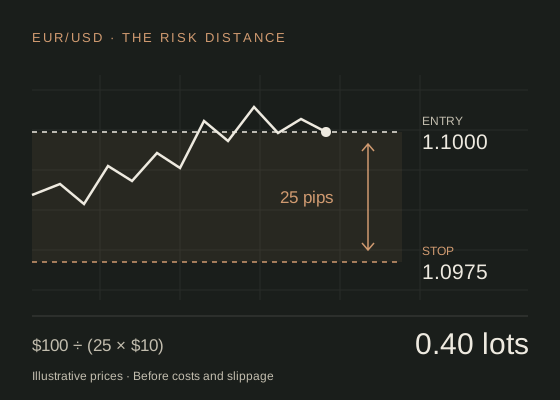
The short answer
Lots = risk budget ÷ (stop distance in pips × pip value per lot). Keep the budget and pip value in the same currency, allow for costs, and round down to your broker’s volume increment.
First, understand what you are sizing.
Position size is the quantity you trade. It determines how much a price move changes your profit or loss. Two people can enter at the same price and use the same stop, yet put very different amounts of money at risk.
For the EUR/USD examples here, one standard lot is 100,000 euros. A 0.10-lot position represents 10,000 euros; 0.01 lot represents 1,000 euros. Check your platform’s contract specification: a field labelled “quantity” might accept units rather than lots.
A pip on EUR/USD is a move of 0.0001. The fifth decimal place is a tenth of a pip, often called a pipette. At one standard lot, the dollar value of one pip is 100,000 × 0.0001 = US$10. At 0.10 lot, it is US$1; at 0.01 lot, US$0.10.
That is the value in US dollars, the pair’s quote currency. If your account is in pounds, convert that pip value into pounds before calculating the size.
Build the calculation in three steps.
1. Express the risk budget in money
Multiply the account amount you are using by your chosen risk percentage, divided by 100. With US$10,000 and an illustrative 1%, the budget is US$100. These examples teach the arithmetic; 1% is not a recommended or universally safe risk level. Existing positions and unrealised losses also matter.
2. Measure the entry-to-stop distance
For EUR/USD, divide the absolute difference between entry and stop by 0.0001. An entry of 1.1000 and a stop of 1.0975 are 25 pips apart. The same absolute-distance method works for a short position with a stop above entry.
3. Divide by the loss per standard lot
Position-size formula
Lots = available price-risk budget ÷ (stop pips × pip value per standard lot)
Available price-risk budget = total risk budget − any amount reserved for costs.
Round the result down to a permitted lot increment. If the calculation gives 0.257 lots and the broker accepts steps of 0.01 lot, use 0.25 in the model. Rounding to 0.26 would exceed the amount allocated to the price move.
The result estimates loss from an assumed entry to an assumed exit. Spreads, commissions, financing, currency conversion and slippage can change the realised loss. A cost reserve is an allowance, not a guarantee.
Same pair. Different account currency.
Both examples use a 25-pip stop, an illustrative 1% budget and no cost reserve. All prices and exchange rates below are hypothetical.
A US-dollar account
- Account amount
- US$10,000
- Risk budget
- US$100
- Stop distance
- 25 pips
- Pip value / lot
- US$10
100 ÷ (25 × 10)
0.40 lots
40,000 EUR units. The modelled price loss is 25 × US$4 = US$100.
A sterling account
- Account amount
- £10,000
- Risk budget
- £100
- Example GBP/USD
- 1.2500
- Pip value / lot
- £8
100 ÷ (25 × 8)
0.50 lots
50,000 EUR units. The modelled price loss is 25 × £4 = £100.
In the sterling example, £1 buys US$1.25, so US$10 per pip ÷ 1.25 = £8 per pip per standard lot. Use GBP/USD, not EUR/USD, for this account-currency conversion. The applicable conversion rate and any broker conversion charges may differ when the position closes.
If the USD example reserves US$5 for costs, the available price-risk budget becomes US$95. That gives 95 ÷ 250 = 0.38 lots. Modelled price loss is US$95; adding the US$5 reserve accounts for the full US$100 budget. Actual costs may be higher.
EUR/USD position-size calculator.
Prefer a focused workspace? Open the standalone calculator in Tools.
Explore how the inputs change the size. Values are illustrative, rates are entered manually, and no account connection is needed. This tool does not assess whether a trade or risk level is suitable for you.
Assumes EUR/USD, 100,000 EUR per standard lot and USD 10 per pip per lot. Inputs stay in your browser. No live prices, trading orders or personal data are sent by this calculator.
The details that change the answer.
- Confusing margin with risk. Margin is collateral needed to hold the position. It is not the loss at your stop. Leverage changes the margin requirement; for the same position size, it does not change the cash value of a pip.
- Counting points as pips. On a five-decimal EUR/USD quote, 250 movements of 0.00001 equal 25 pips. Confirm how your platform labels the distance.
- Mixing currencies. A £100 budget cannot be divided by a dollar pip value without conversion. This can produce a materially different size.
- Ignoring the execution side. A buy opens at the ask and closes at the bid; a sell does the reverse. Measure from realistic execution prices. Do not add the spread again if it is already included in your distance.
- Treating a stop as a guaranteed maximum loss. Gaps and slippage can worsen the exit. Commission, financing and currency-conversion costs can add further losses.
- Copying someone else’s lot size. A signal’s entry and stop do not tell you what size fits your account. Also consider the combined exposure of open trades, including correlated positions.
Common questions.
What lot size should I use for a £1,000 account?
Account size alone is not enough. For an illustrative 1% budget (£10), a 25-pip stop and GBP/USD at 1.25, the calculation gives 10 ÷ (25 × 8) = 0.05 lots before costs. Changing the stop, risk budget or conversion rate changes the answer.
Does a wider stop mean a smaller position?
For an unchanged price-risk budget and pip value, yes. Doubling the stop distance halves the unrounded position size. Choose a stop based on the trade’s logic; moving it just to fit a preferred lot size changes that logic.
What if the calculator returns zero lots?
Your budget does not cover one selected increment. If the broker’s minimum permitted order is larger than the calculated size, that trade does not fit these inputs. Rounding up would exceed the modelled budget.
Can I use this for gold, indices or spread betting?
No. Their contract sizes, tick values and stake conventions differ. This calculator is specifically for EUR/USD using standard lots of 100,000 euros. Check the product specification and use a calculation appropriate to that instrument.
Why can the broker’s result differ?
The broker may use a different conversion rate, contract definition, cost treatment or volume increment. This model does not check available margin, minimum stop distances or order limits. Compare the assumptions with the order ticket before making a decision.
Sources & assumptions.
Prepared by InsomniCapital; see our editorial approach. Calculations and diagrams are original educational examples, not trading results. The references below explain the underlying mechanics; they are not endorsements or evidence of a partnership.
- OANDA: pips, fractional pips and price movements.
- IG: forex contract sizes and product specifications.
- OANDA: how margin and leverage work.
- IG: an illustration of slippage on a non-guaranteed stop (a spread-betting example; the product’s sizing convention differs).
Educational information only, not personalised investment advice. Leveraged trading carries a high risk of loss. Read our risk disclosure. InsomniCapital has an Axi affiliate relationship and may receive compensation for qualifying referrals; this does not change the calculations in this guide.