Trading education · Trading decisions
Forex signals explained.
Read the whole plan.
An alert can describe a setup. It cannot remove uncertainty, choose your position size or guarantee the outcome.
Read the example signal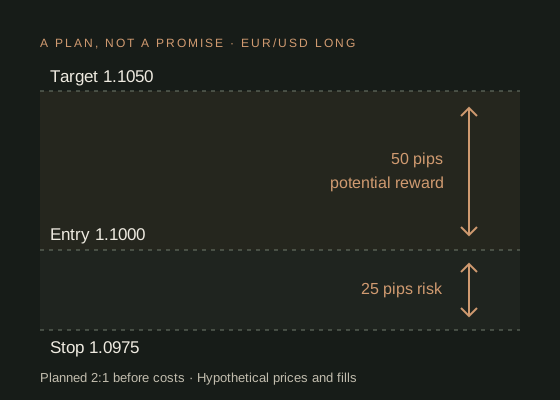
The short answer
A forex signal is an alert about a proposed trade or market condition. Assess the full plan, its timing and its evidence. A high win rate, a screenshot or a stated reward-to-risk ratio does not establish a profitable record.
What a usable signal needs to explain.
A signal may come from a person, a rule-based program or a combination of the two. Before evaluating its result, you need enough detail to know what was proposed and when it became actionable.
- Instrument and direction: the precise symbol and whether the idea is long or short.
- Timestamp and zone: when it was issued, not just when a screenshot was shared.
- Entry condition: market, limit, stop, price range or a condition that must complete first.
- Invalidation and exit: the stop, target, expiry and any management rules.
- Risk assumptions: contract size, costs and whether the stated result assumes perfect fills.
If the provider moves a stop or cancels an entry, that change needs its own timestamp. A message edited after the market moves cannot show what was known beforehand.
Read this hypothetical plan.
Teaching example · Not a live signal
EUR/USD · Long
- Entry
- 1.1000
- Stop
- 1.0975
- Target
- 1.1050
- Distance to stop
- 25 pips
- Distance to target
- 50 pips
The planned reward is twice the planned price risk: 50 ÷ 25 = 2. At 0.10 standard EUR/USD lot, those distances represent USD 50 of gross potential gain and USD 25 of modelled price loss. Costs, conversion and execution can change both.
Now suppose the alert arrives late and the available long entry is 1.1020. Keeping the same stop and target gives 45 pips of risk and 30 pips of potential reward: about 0.67 to 1. It is a different trade. Do not assume the advertised ratio still applies.
The lot size in someone else’s account is not your risk budget. Use the EUR/USD position-size tool or the gold calculator for the appropriate instrument.
Win rate is only one piece of the record.
Expectancy is the average net result per trade. In a simple two-outcome model, it depends on the probability and size of wins and losses, then costs. “R” expresses a result relative to the initially planned price risk.
An illustration, not a forecast
40% wins at +2R; 60% losses at −1R
0.40 × 2R − 0.60 × 1R = +0.20R before costs
If average costs are 0.25R, that same example becomes −0.05R per trade. The assumed win rate is not evidence that a real service achieves it. Conversely, 80% wins at +0.20R and 20% losses at −1R gives −0.04R even before costs.
A target labelled “2R” is not the average realised winner if positions are routinely closed early. Partial exits, trailing stops and breakeven trades need consistent accounting. Ask for cash or percentage results as well as pip totals: equal pip gains on differently sized positions are not equal returns.
Ask for a complete, reproducible record.
- Coverage. Does the record contain every eligible alert, including cancellations, losses and open positions? What period and trade count does it cover?
- Timing. Were entries and changes recorded before the relevant market move? Can deleted or edited messages be identified?
- Execution. Is this a backtest, demo account, model portfolio or live account? What spread, commission, financing and slippage assumptions were used?
- Risk. How large were the positions and maximum drawdown? Were deposits, withdrawals, overlapping trades and floating losses handled consistently?
- Reproducibility. Could a subscriber reasonably obtain the recorded fills after receiving the alert?
Independent account verification can strengthen evidence of a particular history. It does not prove future returns or that every subscriber can reproduce it. A short record or a selected winning week is especially weak evidence of consistency.
Understand the commercial relationship.
Some providers charge a subscription. Others receive broker referral compensation or offer signals alongside another product. A free alert can therefore still involve commercial incentives and trading costs.
InsomniCapital has an Axi affiliate relationship and may receive compensation for qualifying referrals. Read the eligibility requirements and current offer on our homepage. This guide does not establish a verified performance record, confirm account eligibility or promise community access.
Be cautious about guaranteed returns, pressure to deposit quickly, unexplained account access requests and edited win-only screenshots. Independently check the relevant firm and jurisdiction using the regulator’s own records. The CFTC’s forex and social-media advisories describe common warning signs; a polished website alone is not verification.
Review the plan before making a decision.
Check the timestamp, the current available price, the instrument specification and whether the entry remains valid. Recalculate the stop distance, cash risk and potential reward using your own inputs. Include existing exposure and the possibility of worse execution.
Record the decision even when you skip a signal. A journal of alerts received, actual fills, fees and outcomes is more informative than a folder of winning screenshots. The session clock can help label time zones; it cannot validate an entry.
If you cannot explain how the trade loses money, return to the beginner guide before relying on an alert.
Common questions.
Are free signals necessarily poor quality?
No. Price alone does not establish quality. Assess the rules, complete record, execution assumptions and commercial incentives.
Is a 90% win rate enough evidence?
No. You also need loss sizes, costs, sample size, drawdown, open risk and a reliable complete record. A small number of large losses can outweigh many small wins.
Are signals the same as copy trading?
No. An alert supplies information for a decision. Copy trading can replicate orders automatically and introduces its own permissions, execution and risk settings. Check the actual service rather than assuming the terms are interchangeable.
Sources & assumptions.
Prepared by InsomniCapital; see our editorial approach. Sources checked on 2 October 2026. Diagrams, calculations and scenarios are original educational illustrations, not live quotes, trade recommendations or reported trading results.
- CFTC: forex fraud warning signs and limits of signal software.
- CFTC: checking providers promoted through social media.
Educational information only, not personalised investment advice. Leveraged trading carries a high risk of loss. Read our risk disclosure. InsomniCapital has an Axi affiliate relationship and may receive compensation for qualifying referrals. References are not endorsements of this guide.