Trading education · Risk management
Gold position size
calculator.
A dollar move in gold is not a forex pip. Start with troy ounces per lot, then translate the stop distance into cash risk.
Calculate gold position size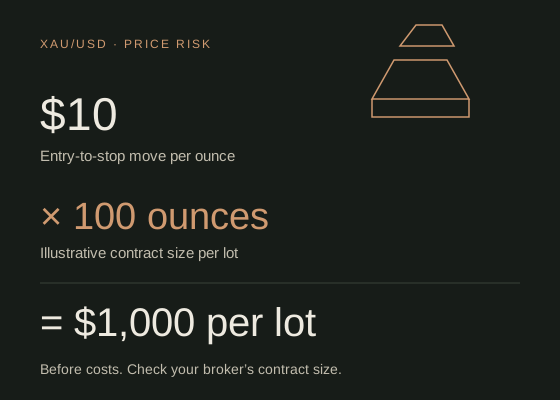
The short answer
Gold lots = available price-risk budget ÷ (entry-to-stop distance × troy ounces per lot), with currency conversion where needed. Round down to a permitted lot increment and check the minimum. An ordinary stop cannot guarantee the modelled loss.
Read the gold contract first.
XAU/USD quotes gold in US dollars per troy ounce. Axi’s referenced gold CFD specification lists 100 ounces per lot, but that is a product example rather than a universal rule. Check your own broker, account, symbol and jurisdiction.
At 100 ounces per lot, a US$1 move per ounce changes a one-lot position by US$100 before costs. At 0.10 lot, it changes the position by US$10. Calling a move “ten pips” is not enough: gold pip and point labels vary between platforms. This calculator uses actual entry and stop prices instead.
This tool models a linear, USD-quoted gold contract sized in lots. It does not model futures contracts, options, ETFs, spread-betting stakes or physical ownership.
Work through one position by hand.
Take a hypothetical USD 10,000 account and a chosen 1% budget: USD 100. For a long example with entry at USD 2,400 per ounce and stop at USD 2,390, the distance is USD 10 per ounce. These prices and the risk percentage are illustrative, not live quotes or recommendations.
No-cost example, 100 ounces per lot
Loss per lot = 10 × 100 = USD 1,000
Position = 100 ÷ 1,000 = 0.10 lot
That position represents 10 ounces. If you reserve USD 5 for costs, only USD 95 remains for the price move. At 0.01-lot increments the size becomes 0.09 lot, modelling USD 90 of price loss plus USD 5 reserved. Rounding to 0.10 would exceed that combined budget.
For a GBP 100 budget at an illustrative rate of USD 1.25 per pound, the same one-lot move is GBP 800. With no cost reserve, 100 ÷ 800 = 0.125 lot; rounding down to 0.01 increments gives 0.12 lot and GBP 96 of modelled price loss.
Calculate with your contract assumptions.
Prefer a focused workspace? Open the standalone calculator in Tools.
Replace the examples with the specification you want to examine. All money inputs except the entry and stop use your selected account currency. Inputs stay in your browser.
What can make the actual loss different?
- Execution. A long opens on the ask and exits on the bid; a short reverses those sides. Use the appropriate execution prices and avoid counting a spread twice.
- Slippage and gaps. An ordinary stop is not a guaranteed fill at the specified price.
- Costs. Commission, financing and conversion charges can depend on size and holding period. A fixed reserve is only an assumption; review it against the resulting size.
- Currency conversion. This model uses one manual USD-per-account-unit rate. The broker’s exit conversion may differ.
- Margin. Fitting the risk budget does not mean sufficient free margin exists.
- Contract changes. Minimum size, volume step, maximum size and contract units must match your product.
If the calculated amount is below the minimum, the result is zero. The tool will not round up to force a trade to fit. If the maximum is reached, it caps the result even if some risk budget remains unused.
Common questions.
How much does 0.01 lot of gold represent?
At 100 troy ounces per lot, 0.01 lot is one ounce of exposure. A USD 1 move then creates USD 1 of gross profit or loss. A different contract size changes that answer.
Can I use a short setup?
Yes. Select short and enter a stop above the entry. The model uses that adverse price distance; a stop on the wrong side is rejected.
Does this place an order?
No. It performs an educational calculation in your browser. It does not connect to a broker, fetch prices or confirm that a trade is permitted.
Sources & assumptions.
Prepared by InsomniCapital; see our editorial approach. Sources checked on 2 October 2026. Diagrams, calculations and scenarios are original educational illustrations, not live quotes, trade recommendations or reported trading results.
Educational information only, not personalised investment advice. Leveraged trading carries a high risk of loss. Read our risk disclosure. InsomniCapital has an Axi affiliate relationship and may receive compensation for qualifying referrals. References are not endorsements of this guide.