Trading education · Market structure
Forex market hours.
Your time zone.
Four trading centres. Different time zones. One clear view of the sessions, wherever you are.
Open the session clock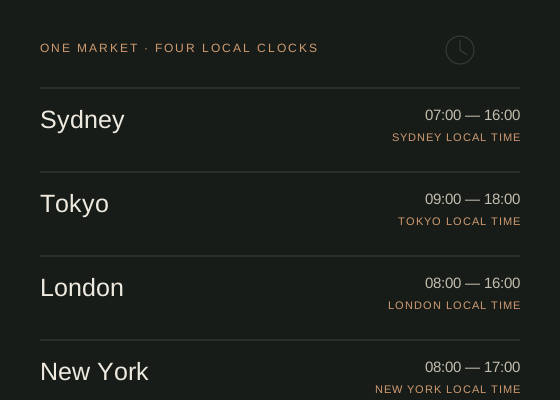
The short answer
Forex is an over-the-counter market. The session clock below translates reference business hours into your selected time zone, including daylight-saving changes. It does not check holidays or whether your broker is accepting orders.
The sessions, in your time.
Prefer a focused workspace? Open the standalone session clock in Tools.
Enable JavaScript for the live clock. The local-hours table below remains available without it.
Reference session clock
All times below use . Updates every 30 seconds using your device clock.
Bronze blocks mark hours that intersect a reference session within the next 24 hours. Read the exact times above each bar.
Status means “within the reference window”, not “safe to trade”. Incorrect device time will produce an incorrect clock. Holiday closures and unusual broker schedules are not modelled.
The schedule this clock uses.
Session definitions vary between providers because spot forex has no single central exchange. We use the following local business-hour convention, based on FOREX.com’s session guide. These are deliberately stated in each city’s own time rather than treated as fixed UTC hours.
| Centre | Local hours | Time zone |
|---|---|---|
| Sydney | 07:00–16:00 | Australia/Sydney |
| Tokyo | 09:00–18:00 | Asia/Tokyo |
| London | 08:00–16:00 | Europe/London |
| New York | 08:00–17:00 | America/New_York |
The clock also applies a reference forex week of Sunday 17:00 to Friday 17:00 in New York. If Sydney’s Monday window starts before that reference opening, only the portion after opening appears. Your broker can begin later or pause dealing; the clock does not override its specification.
Why the same session moves on your clock.
London, New York and Sydney change their clocks on different dates. Tokyo does not currently observe daylight saving. A session can therefore move by an hour relative to your location even when its local business hours stay unchanged.
Consider our London–New York convention. On 2 February 2026, the overlap is 13:00–16:00 UTC. On 16 March, after the US clock change but before the UK change, it becomes 12:00–16:00 UTC. On 6 April, it is 12:00–15:00 UTC. These are timezone calculations, not broker opening promises.
The live tool uses named time zones and your browser’s timezone rules rather than a hard-coded “GMT offset”. Keep your browser and operating system current. A fixed UTC screenshot saved in winter may be wrong in summer.
What an overlap does—and does not—tell you.
An overlap means that two reference sessions are active together. It gives a useful time context, but it does not establish the next price direction or prove a strategy has an edge.
For example, someone studying EUR/USD might tag journal entries as London-only, overlap, or late New York. Compare the same entry rules and record spread, slippage and scheduled news. Changing the session filter and the entry rules together makes it difficult to tell which change affected the results.
Do not confuse movement with opportunity. A fast market can move through an ordinary stop at a worse price. A quiet market can have a spread that consumes a large share of a small target. Position sizing and execution costs still matter.
Use the clock as a planning aid.
- Check the instrument. A currency pair, gold CFD and index CFD may have different dealing hours.
- Confirm your display zone. Platform server time can differ from your device time. Record the zone alongside journal timestamps.
- Read the broker’s holiday notice. A normal weekday can still have reduced hours or thin liquidity.
- Review scheduled events. The clock is not an economic calendar and does not flag announcements.
- Set your risk before the order. Use the EUR/USD sizing guide to understand the arithmetic.
Common questions.
Is forex open all weekend?
No. The reference retail FX week has a weekend break. Indicative quotes or weekend products do not mean an ordinary currency-pair order can be executed.
Why does my broker show different hours?
The broker sets its dealing schedule, server time, maintenance periods and holiday changes. A session is a reference activity window, not an instruction to your broker.
Does the clock work for XAU/USD?
It provides time-zone context only. Gold CFDs can have daily breaks and different holiday closures. Check the gold contract’s schedule separately.
Sources & assumptions.
Prepared by InsomniCapital; see our editorial approach. Sources checked on 2 October 2026. Diagrams, calculations and scenarios are original educational illustrations, not live quotes, trade recommendations or reported trading results.
- FOREX.com: local session-hour convention and seasonal changes.
- BabyPips: forex session time conversion.
- FOREX.com: instrument schedules and holiday limitations.
Educational information only, not personalised investment advice. Leveraged trading carries a high risk of loss. Read our risk disclosure. InsomniCapital has an Axi affiliate relationship and may receive compensation for qualifying referrals. References are not endorsements of this guide.