Trading education · Margin & execution
Margin Calls and Stop-Outs: Equity, Warnings and Closeout
Understand margin-call warnings and forced closeout using an equity and margin-level example. Learn why thresholds, platform labels and protections vary.
The short answer
A margin call concerns whether account resources satisfy the provider’s requirements. A stop-out or margin closeout is a risk-control action that can close positions. These account-level rules differ from a trade’s stop-loss order, and a warning is not a promise of time to react or a guaranteed execution price.
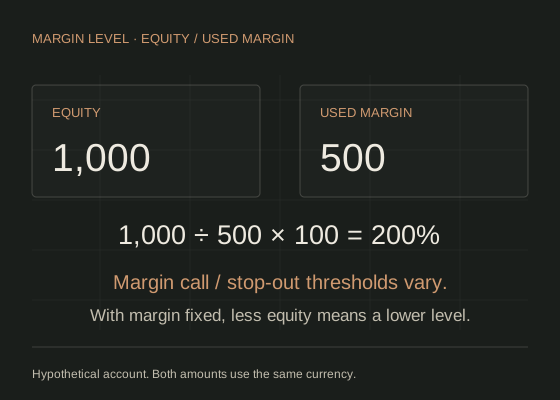
Distinguish a margin warning from a stop order.
A protective stop belongs to a position or order plan. Margin controls concern whether the account can continue supporting its combined exposure. The provider may reject a new order or close existing exposure when applicable requirements are no longer met, even if a particular trade’s own stop has not triggered.
OANDA Corporation: margin requirements and closeout describes automatic closeout under one provider entity’s rules. That is not a universal sequence. A message, platform colour or margin-call label should not be interpreted as a contractual grace period. Price movement and communication delays can leave little opportunity to react.
Start with margin versus leverage if notional exposure and required margin are unfamiliar. This guide focuses on what happens as account resources change, rather than repeating the initial margin calculation.
Read the account quantities together.
In a simplified account with no credit adjustments, equity equals balance plus unrealised P/L, with any already recognised charges included consistently. Used margin is the requirement supporting existing positions. Free margin is equity minus used margin. These are snapshots; floating P/L, exchange rates and margin requirements can change.
Illustrative margin level (%) = equity ÷ used margin × 100
OANDA Canada: platform margin terminology and rules demonstrates that platform names and percentage conventions need care. Some interfaces display a closeout-utilisation measure rather than this equity-to-margin ratio. A higher number can therefore mean more headroom in one display and less in another. Read the formula, not just the label.
With no used margin, the displayed ratio may be blank or handled specially; dividing by zero does not produce a meaningful ordinary percentage. Account-level hedging, netting, conversion and credit treatment also depend on the applicable rules.
Follow an account towards two hypothetical thresholds.
Assume a USD 2,000 starting balance and fixed USD 1,000 used margin. For this exercise only, define a warning at margin level at or below 100%, and closeout at or below 50%. These thresholds are invented assumptions, not an account offer or a statement of any provider’s policy.
| Unrealised P/L | Equity | Free margin | Margin level |
|---|---|---|---|
| −USD 600 | USD 1,400 | USD 400 | 140% |
| −USD 1,100 | USD 900 | −USD 100 | 90% |
| −USD 1,500 | USD 500 | −USD 500 | 50% |
The second row breaches the example warning level. The third reaches the example closeout level. Free margin becoming negative is not a universal instruction about exactly which position closes first: that follows the provider’s actual methodology.
If a price gap moves equity straight from USD 1,400 to USD 400, the model crosses both thresholds between displayed observations. A warning cannot freeze prices at USD 1,000 equity. Fees, conversion and execution differences would change the final account figures.
Understand what a closeout changes.
Closing a position converts its floating P/L into realised P/L and normally releases its associated margin requirement, subject to the account’s netting and calculation rules. It does not refund the trading loss. Partial liquidation can change the denominator of the remaining margin ratio while other positions continue moving.
For an illustrative account with USD 500 equity and USD 1,000 used margin, closing exposure that releases USD 400 of required margin leaves USD 600 used. If equity were otherwise unchanged, the ratio would become 500 ÷ 600 × 100 = 83.33%. Actual fills and costs can also change equity, so this is an explanation of the denominator, not a forecast of a closeout sequence.
Check which positions may be closed, how non-tradable instruments are treated, and whether pending orders remain. Do not assume a provider will select the position you would personally have chosen.
Do not treat spare margin as a risk budget.
An account can have positive free margin and still be exposed to a large adverse move. Several trades can also share the same underlying currency exposure. Three individually small USD-sensitive trades are not necessarily three independent risks.
Requirements can vary by instrument, entity, account classification or exposure tier. A calculation using yesterday’s terms can be wrong after a requirement changes. Negative-balance protections, where applicable, have their own scope and conditions; they are not a substitute for understanding liquidation or a reason to assume every account has the same protection.
Adding funds changes available resources but does not remove the economic risk of the position. Decide how to manage exposure from a considered plan, rather than assuming an urgent top-up must be the correct response.
Audit a demo account’s closeout rules.
- Identify the exact provider entity, account and platform.
- Copy the published equity, margin and percentage definitions into your notes.
- Record warning and closeout conditions, including whether notification is guaranteed.
- Reconcile one hypothetical account snapshot by hand.
- Model an adverse gap and a partial closeout, keeping changed margin and changed equity separate.
Use a demo or paper exercise; there is no need to push a funded account towards liquidation to learn its arithmetic. The drawdown calculator answers a different question about assumed losses and recovery, not provider closeout eligibility.
Common margin-closeout questions.
Is 100% margin level the same across all platforms?
No. Confirm the numerator, denominator and threshold rules. Similar labels can describe different ratios.
Can a closeout happen before my position’s stop-loss?
Yes. Account-level requirements and a position’s stop trigger are separate conditions.
Does releasing margin recover the money lost on the trade?
No. Released margin is a reduced requirement supporting exposure; realised trading losses remain in the account result.
Sources & assumptions.
Prepared by InsomniCapital; see our editorial approach. Sources checked on 2 October 2026. Schematics and hypothetical calculations are labelled educational illustrations. Historical observations identify their source, dates and method separately. Neither is a live quote, trade recommendation or reported trading result.
- OANDA Corporation: margin requirements and closeout.
- OANDA Canada: platform margin terminology and rules.
- OANDA Corporation: pending entry orders and margin checks.
Educational information only, not personalised investment advice. Leveraged trading carries a high risk of loss. Read our risk disclosure. InsomniCapital has an Axi affiliate relationship and may receive compensation for qualifying referrals. References are not endorsements of this guide.