Trading education · Trading costs
Forex Spreads, Slippage and Swaps: Trading Costs Explained
Calculate spreads, slippage, commission and overnight financing with worked forex examples. Avoid double counting and compare costs in one currency.
The short answer
Spread is the gap between available buy and sell quotes. Slippage is the difference between a stated reference and the actual execution. Overnight financing is a separate holding charge or credit. Reconcile each component in the account currency and avoid subtracting a spread already embedded in executable prices.
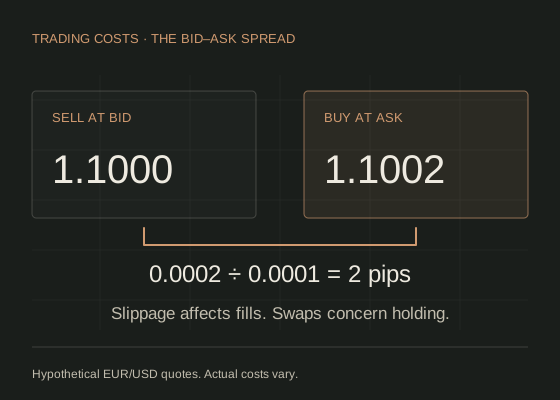
Separate the costs before adding them.
Two trades with the same chart entry and target can produce different cash results because their executable prices and charges differ. Start with a cost map: the bid/ask difference, any execution deviation, commission, financing and conversion. A provider may bundle some charges into its quote while applying others separately.
| Component | Measurement | Check before combining |
|---|---|---|
| Spread | Ask minus bid at a stated time. | Whether it is already represented in entry and exit prices. |
| Slippage | Actual fill versus a defined reference price. | Direction, quote side, timestamp and filled quantity. |
| Commission | Fee per trade, unit or lot, possibly with a minimum. | Per side versus round turn, tiers and currency. |
| Financing / swap | A holding debit or credit under the provider’s schedule. | Rate, calculation base, cutoff and number of settlement days. |
OANDA Corporation: trading charges and currency conversion illustrates why conversion and holding charges need separate attention. It describes one provider entity, not a universal tariff or a quotation for your account.
Calculate spread using bid and ask.
Take hypothetical EUR/USD bid 1.1000 and ask 1.1002. Ask minus bid is 0.0002, or two pips. With 10,000 EUR units, each 0.0001 move is USD 1. A long bought at 1.1002 and sold immediately at the unchanged 1.1000 bid loses USD 2 on price.
Now suppose the later quote is bid 1.1010, ask 1.1012. Selling the long at 1.1010 creates a gain of 0.0008 × 10,000 = USD 8. That executed-price difference already reflects the spread. Subtracting a further two pips would count it again. A separate USD 0.70 round-trip commission would reduce the result to USD 7.30.
Spread measured at entry is not necessarily spread at exit. Record both when comparing execution with a mid-price or single-sided chart. An advertised minimum spread is not the average cost of your actual observation window.
Measure slippage against a named reference.
Slippage needs a benchmark. A market-order request quote, a stop trigger and a backtest’s assumed next-bar price are different references. Define which you are comparing before counting pips. For a sell, a lower fill than the reference is adverse; for a buy, a higher fill is adverse.
For example, a long’s sell-stop trigger is 1.1000 but its fill is 1.0997. The adverse difference is three pips. At 20,000 EUR units, or USD 2 per pip, the extra price loss is USD 6. Execution at 1.1001 would instead be one pip favourable relative to that trigger.
Ordinary stops can slip, while a limit can remain unfilled when its price condition cannot be met. OANDA UK: order types and execution examples explains the distinction. Large event moves, thin available liquidity and gaps can change the outcome; a calm-period average is not a guaranteed allowance for every trade.
Keep fee units and minimums visible.
Suppose a schedule charges USD 7 per full lot for opening and closing together. At 0.10 lot, a purely linear schedule charges USD 0.70. If USD 7 were instead a per-side rate, the round-trip amount at the same size would be USD 1.40. The phrase “per lot” alone is incomplete.
Minimum commissions or tiered fees can break that simple multiplication. Record the actual account schedule and convert amounts consistently. For position sizing, a total USD 5 reserve and a USD 5-per-lot fee are not interchangeable. The cost-aware position-size guide works through their different denominators.
Understand overnight financing without assuming a fixed swap.
Rolling exposure across a provider’s cutoff can produce a financing debit or credit. Long and short rates can differ; one side’s debit does not guarantee an equal credit on the other. Rates, administration adjustments and settlement dates belong to the actual product and entity.
OANDA Corporation: financing calculations and settlement-day adjustments documents one daily model and explains why weekends and holidays can change the number of financing days. Its timing should not be copied automatically to another broker or instrument. Check the published cutoff’s named time zone and daylight-saving treatment.
As a purely hypothetical annualised-debit exercise, USD 10,000 of position value at 6% for one day on a 365-day basis costs 10,000 × 0.06 ÷ 365 = approximately USD 1.64. Three financing days cost approximately USD 4.93 before rounding conventions. This is a specified arithmetic model, not a current swap quote or a universal broker formula.
Some products use different bases, units or accrual methods. Short holding time does not by itself avoid financing if the position crosses the relevant cutoff.
Build a net-result reconciliation.
Create a hypothetical ledger with instrument, quantity, entry and exit timestamps, executable quote sides, fill prices, separate fees and financing. Start with executed-price P/L, then add credits and subtract debits not already included. Keep every amount in a stated currency.
Repeat the same plan under a normal spread, a wider spread and an adverse fill. Label these as scenarios, not measured frequencies. Use the profit calculator to check arithmetic and explain what its manual inputs omit. If a backtest assumes zero slippage or financing, write that limitation alongside its result rather than hiding it in a separate note.
Common trading-cost questions.
Is a zero-commission account cost-free?
No. Spread, execution differences, financing or other applicable charges can remain. Compare complete terms, not one fee label.
Is every Wednesday automatically a triple-swap day?
No universal rule applies across products and providers. Settlement conventions and holidays can alter the number of days charged.
Can a positive swap make a trade risk-free?
No. Price losses, spread, costs and changing funding rates can outweigh any financing credit.
Sources & assumptions.
Prepared by InsomniCapital; see our editorial approach. Sources checked on 2 October 2026. Schematics and hypothetical calculations are labelled educational illustrations. Historical observations identify their source, dates and method separately. Neither is a live quote, trade recommendation or reported trading result.
- OANDA UK: order types and execution examples.
- OANDA Corporation: financing calculations and settlement-day adjustments.
- OANDA Corporation: trading charges and currency conversion.
Educational information only, not personalised investment advice. Leveraged trading carries a high risk of loss. Read our risk disclosure. InsomniCapital has an Axi affiliate relationship and may receive compensation for qualifying referrals. References are not endorsements of this guide.