Trading education · Orders & execution
Forex Order Types: Market, Limit, Stop and Stop-Limit
Compare forex market, limit, stop and stop-limit orders with bid/ask examples. Learn about triggers, execution, expiry and unfilled orders.
The short answer
An order describes the conditions under which you ask a provider to execute a trade. Market orders prioritise execution, limits constrain the acceptable price, and stops introduce a trigger. No order label removes the need to check quote side, availability, size and broker-specific rules.
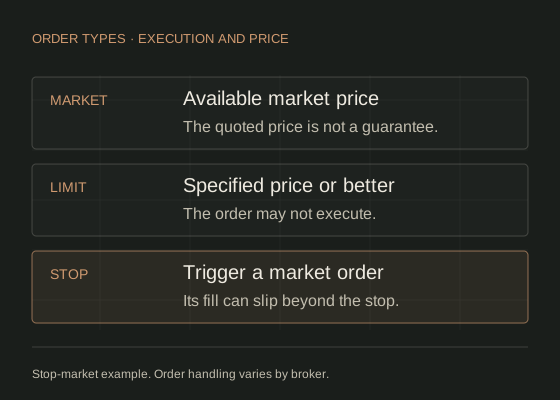
Start with the instruction, not the button.
An order ticket connects an intention to execution rules. It should identify the instrument, buy or sell direction, quantity, order type and any trigger, price boundary or expiry. An accepted pending order is not yet an open position. A position exists only when an execution occurs; a partially filled order may leave both an open position and an unfilled remainder.
Investor.gov: market, limit and stop orders (securities examples) explains the basic trade-off between requesting execution and controlling price. Its examples concern securities. OANDA UK: order types and execution examples shows related forex conventions, but names, available features and trigger rules still depend on the broker entity, account and platform.
Separate an entry order from an attached exit. A buy stop might open a long position above the market, or close an existing short as a protective stop. The direction alone does not tell you which job it performs.
Compare four common order types.
| Order | Instruction | Main execution limitation |
|---|---|---|
| Market | Execute the requested trade at available prices. | The displayed quote is not a guaranteed fill price. |
| Limit | Buy at the limit or lower; sell at the limit or higher. | The order may remain unfilled or fill only partly. |
| Stop | Activate an execution instruction after the specified trigger. | An ordinary stop can execute beyond the trigger price. |
| Stop-limit | After a stop trigger, apply a limit-price instruction. | A fast move can leave the triggered limit unfilled. |
A standard marketable limit can execute immediately if an acceptable price is available; “limit” does not necessarily mean waiting for a pullback. A stop-limit is available only where the product and platform support it. Do not confuse a pending buy limit with a guaranteed stop-loss service: they solve different problems and have different conditions.
Use the correct side of a hypothetical quote.
Suppose EUR/USD shows bid 1.1000 and ask 1.1002. The spread is 0.0002, or two pips using a 0.0001 pip. A market buy generally opens near the available ask; an immediate sale generally uses the bid. At an illustrative 0.10 lot representing 10,000 EUR, the unchanged quote produces USD 2 of price loss before additional charges.
A buy limit at 1.0990 asks for that price or better. A chart displaying only bid might touch 1.0990 while ask remains above it. That chart touch alone therefore does not establish an eligible buy fill. Even an eligible quote must be considered alongside liquidity, quantity and the provider’s execution policy.
A buy stop above the market instead waits for an upward trigger. Once activated, its execution can differ from the trigger. Record whether the broker tests bid, ask or another reference; do not infer it solely from the candle visible on your chart.
See why a stop-limit can leave exposure open.
Consider a hypothetical long with a sell stop-limit: stop trigger 1.0990 and limit 1.0988. If the next available bid after the trigger is 1.0985, selling there would violate the minimum permitted sale price. The triggered limit may remain open while the position continues losing value.
An ordinary sell stop prioritises getting out once triggered, subject to available execution, and might fill near 1.0985 instead. Relative to 1.0990, that is five pips of adverse slippage. At USD 2 per pip, it adds USD 10 to the price loss. Neither example establishes what any particular provider would fill.
The choice is a trade-off: constraining execution price can leave a trade unfilled; seeking execution can expose the fill price to movement. See stop distances and execution before treating the trigger as a guaranteed loss cap.
Check acceptance, expiry and the remaining order.
Before submitting, confirm minimum size, size step, available margin and any minimum distance from market. A pending order can become ineligible when it triggers. OANDA Corporation: pending entry orders and margin checks describes an implementation in which insufficient margin can cause a triggered entry to be rejected.
Choose expiry deliberately. A good-till-cancelled instruction is governed by the provider’s validity rules; a dated expiry needs the correct time zone. After a disconnect or a cancellation request, check the confirmed status instead of assuming the order disappeared. Sending a replacement without reconciling the first order can create unintended duplicate exposure.
Attached stops, targets, trailing instructions and linked-order cancellation can behave differently across platforms. Establish whether they survive logout and what happens after a partial fill. A demo exercise can reveal interface behaviour, but it does not prove identical live fills or liquidity.
Practise a complete order ticket.
- Write a hypothetical bid and ask, quantity and contract units.
- Choose an entry instruction and state its acceptable execution conditions.
- Write the exit trigger, permitted execution price if applicable, and expiry.
- Model a normal fill, a price gap and an unfilled or rejected order.
- Reconcile cash exposure with the position-size calculator and the actual size rules.
The useful result is a ticket another person could interpret consistently. It is not a recommendation to place it. Save both expected and adverse scenarios so a clean fill does not become the only outcome considered.
Common order-type questions.
Is a limit order guaranteed to fill when a chart touches it?
No. Quote side, available quantity and execution rules matter, and a chart may not show the executable side.
Is a trailing stop automatically a guaranteed stop?
No. Trailing describes how a trigger can move. A contractual guaranteed-stop feature, where available, has separate eligibility and charging rules.
Does cancelling an order always happen before the next price change?
No. A request can arrive while an execution is already taking place. Reconcile the confirmed order and position status.
Sources & assumptions.
Prepared by InsomniCapital; see our editorial approach. Sources checked on 2 October 2026. Schematics and hypothetical calculations are labelled educational illustrations. Historical observations identify their source, dates and method separately. Neither is a live quote, trade recommendation or reported trading result.
- Investor.gov: market, limit and stop orders (securities examples).
- OANDA UK: order types and execution examples.
- OANDA Corporation: pending entry orders and margin checks.
Educational information only, not personalised investment advice. Leveraged trading carries a high risk of loss. Read our risk disclosure. InsomniCapital has an Axi affiliate relationship and may receive compensation for qualifying referrals. References are not endorsements of this guide.