Trading education · Trading strategies
Range-Trading Strategy: Boundaries, Costs and Invalidation
Work through a forex range-trading example with fixed boundaries, a rejection trigger, target arithmetic, expiry rules and genuine-breakout failure cases.
Explore the guide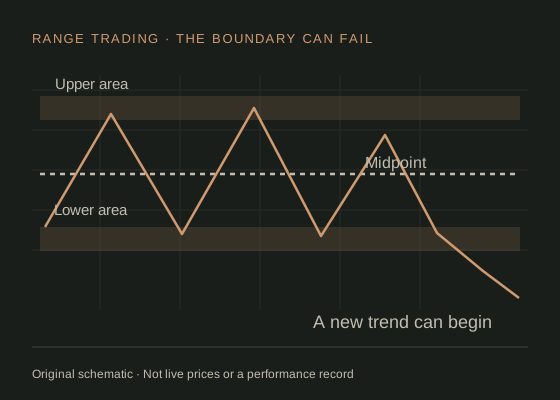
The short answer
A range-trading method tests whether price continues to move between boundaries rather than extending beyond them. Mark the range before the trade, define a rejection observation, and specify when the range is no longer eligible. A real breakout is a central failure mode.
Define the range before the return to it.
This is an original, unvalidated study specification. Its numerical settings are teaching choices, not optimised parameters, personalised advice or evidence of profitability. All prices below are hypothetical.
This long-only teaching example tests a return away from a lower boundary towards the middle of a range. It uses fixed levels for one observation session. The purpose is to make each decision reviewable, not to claim that these times or thresholds identify profitable ranges.
Fidelity: support, resistance and role reversal explains the support/resistance convention. A support label describes past observations; it does not prevent price breaking lower. Adding an RSI threshold would change the specification and should be evaluated as a separate variant.
A fully stated example range specification.
| Component | Teaching rule |
|---|---|
| Reference window | Use five-minute bid OHLC from 06:00 inclusive to 09:00 exclusive, UTC. Freeze the high and low at 09:00. |
| Eligibility | Range width must be 30–60 pips. Require two distinct visits to each outer 10% of the range, with each repeated visit separated by a close in the middle 50% of the range. |
| Signal | Between 09:00 and before 11:00 UTC, use the first completed bar whose low reaches the bottom 10% and whose close returns above that 10% boundary. |
| Entry | Buy at the next ask only if it remains below the range midpoint, spread is at most 2 pips, and the gross distance to the midpoint is at least the entry-to-stop distance. |
| Stop and exit | Bid stop: frozen low minus 2 pips. Bid target: frozen midpoint. Exit any remaining position at the first bid at or after 12:00 UTC. |
| Invalidation | Before entry, a completed close outside the frozen range cancels it for that day. One entry maximum; no re-entry after a stop. |
| Event and data filter | Skip the first signal if entry is within 15 minutes before or after a pre-scheduled high-impact EUR or USD event, or if quotes/calendar history are unavailable. |
The middle-50% condition gives repeated visits a specific meaning: the price must leave an edge before a further visit counts. It is a reproducibility convention, not a claim that two tests make a boundary strong.
The midpoint can leave less room than expected.
Assume an eligible frozen range from 1.1000 to 1.1040. Its width is 40 pips, its midpoint 1.1020 and its bottom-10% boundary 1.1004. A completed signal bar visits 1.1002 and closes at 1.1006. Suppose the next ask is 1.1008 and the spread passes the filter.
The bid stop is 1.0998, 10 pips below entry. The midpoint is 12 pips above entry. The gross ratio is therefore 1.2:1, even though the entire range is 40 pips wide. The distance you can trade from the available entry matters more than the total size of the shape.
At a hypothetical USD 1 per pip and USD 0.70 additional round-trip commission, an exact stop fill loses USD 10.70 and an exact midpoint exit gains USD 11.30. The net ratio is about 1.056:1. Ignoring other exits and slippage, the corresponding break-even win rate is approximately 48.64%.
If the available ask were instead 1.1015, the five-pip distance to the midpoint would be less than the seventeen-pip stop distance, so the trade would be skipped. Do not use the earlier signal close as an invented fill.
The failure is a genuine change of state.
Price can break through 1.1000 and continue lower. Repeatedly buying the falling market because it used to be the range low abandons the one-entry rule and can concentrate losses. The boundary should not be moved down after each loss merely to preserve the range label.
An ordinary stop can fill beyond its trigger in a fast move. A scheduled-event filter cannot remove unscheduled news. Range-trading examples that show only gentle oscillations omit the failure that most needs to be understood.
A second awkward case is a range that remains intact but never offers a qualifying rejection or tradable entry. Record no trade. A rule does not need to produce a position every session to be a coherent study specification.
Evaluate the whole entry and exit process.
Preserve the frozen boundaries, eligibility visits and timestamps. Verify that all reference candles were complete at 09:00. Use bid/ask data to model entry and exits, and handle a bar crossing both stop and target with finer data or a conservative declared rule.
Separate the counts for eligible ranges, signals, accepted entries and completed trades. A high percentage of ranges that “held” is not the win rate of the executed method. Costs and the first available entry can change that result substantially.
Compare the process on a later untouched period, including days when ranges broke. Use the risk/reward calculator for scenario arithmetic and the strategy research framework for reporting limitations.
Work through it yourself.
Record the plan, execution assumptions, outcome and lessons from a practice trade.
Download trading-review worksheet PDF · 2 pagesFree to download without registering. Practice examples explain the method; they do not establish a profitable strategy.
Common range-trading questions.
Can I keep trading a range until it breaks?
That is a separate rule requiring explicit exposure and loss limits. This teaching specification permits only one entry and cancels the range after a pre-entry close outside it.
Is RSI below 30 enough for a range entry?
No. It does not establish that a range exists or will continue. If an RSI condition is added, define it and evaluate the resulting method separately.
Why use a midpoint target?
It makes this example specific and illustrates limited available reward. A far-boundary target would have different fill frequency, holding time and failure behaviour. Neither is validated here.
Sources & assumptions.
Prepared by InsomniCapital; see our editorial approach. Sources checked on 2 October 2026. Schematics and hypothetical calculations are labelled educational illustrations. Historical observations identify their source, dates and method separately. Neither is a live quote, trade recommendation or reported trading result.
- Fidelity: support, resistance and role reversal.
- Investor.gov: order execution risks (securities examples).
- Fidelity: RSI definition and calculation.
Educational information only, not personalised investment advice. Leveraged trading carries a high risk of loss. Read our risk disclosure. InsomniCapital has an Axi affiliate relationship and may receive compensation for qualifying referrals. References are not endorsements of this guide.