Trading education · Trading process
Trading Psychology: Decision Habits, Biases and Review
Build a practical trading-review process around decisions, bias, risk and evidence. Separate rule adherence from outcomes without promises of profitability.
The short answer
Trading psychology concerns how attention, expectations and emotions interact with decisions. A useful review records what was knowable, what rule was chosen and what actually happened. Discipline cannot make a negative-expectancy strategy profitable, and a single win does not validate an impulsive decision.
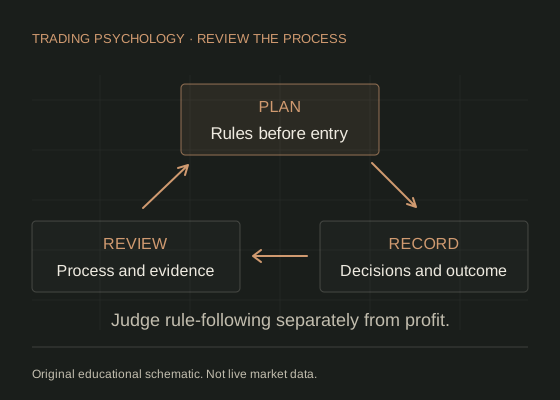
Start with observable decisions.
“Be more disciplined” is difficult to audit. “Do not change this example’s stop after entry unless the prewritten trailing condition occurs” is a specific behaviour that can be recorded. The purpose of a review is to identify decisions and their consequences, not to assign a fixed personality label after every losing trade.
The SEC: summary of the commissioned report on investor behaviour describes recurring investor behaviours, including active trading, the disposition effect and ignoring fees. Its evidence concerns investors, substantially in securities markets; it is not a diagnosis of every forex trader or proof that one psychological technique produces returns.
Separate three questions: was the rule clear, was it followed, and did the rule have adequate evidence behind it? Reliable execution of an unprofitable method is still unprofitable. Poor execution of a sound-looking plan also needs investigation.
Translate common biases into review questions.
| Pattern to examine | Observable question | Useful record |
|---|---|---|
| Overconfidence | Did recent wins lead to a size increase unsupported by the plan? | The old size rule, new size and reason recorded at the time. |
| Disposition effect | Was a loser retained or a winner closed because of discomfort rather than the exit rule? | The planned exit, actual action and information available then. |
| Confirmation seeking | Were contradictory observations ignored after choosing a direction? | Evidence for and against the original hypothesis. |
| Outcome-based judgement | Was a rule breach excused only because this trade won? | Process assessment written separately from cash P/L. |
| Chasing activity | Was the next order placed to recover a loss or copy attention online? | A timestamped trigger and whether the predefined entry conditions existed. |
The Library of Congress for the SEC: Behavioral Patterns and Pitfalls of U.S. Investors provides broader research context. These prompts are our practical application, not a validated screening test. A single deviation may reflect an unclear rule, a technical problem or genuinely changed information; record the explanation before deciding what to improve.
Keep process and outcome in separate columns.
Consider five invented practice records whose outcomes already include the chosen cost model. Three followed the written rule; two overrode it. The examples illustrate record-keeping, not a real strategy’s performance.
| Record | Rule followed? | Net result | Review point |
|---|---|---|---|
| A | Yes | +80 | Winning result; still check the execution record. |
| B | Yes | −40 | A loss can occur without a rule breach. |
| C | Yes | −40 | Another compliant loss is not automatically a reason to redesign the rule. |
| D | No | +100 | A winning override does not prove the override is beneficial. |
| E | No | −160 | Record the breach and larger loss without hiding either. |
The adherence rate is 3 ÷ 5 = 60%; the win rate is 2 ÷ 5 = 40%; net P/L is −USD 60. These are different measurements. Five selected examples cannot establish whether adherence causes better returns, whether the rule has an edge, or how often any outcome will recur.
Use a small before-and-after routine.
Before: write the instrument, complete entry condition, invalidation, expiry, chosen cash budget and cost assumptions. Identify conditions that mean no trade. The strategy rulebook supplies a structure; it does not choose a suitable risk level for you.
During: record fills and any deviation with timestamps. Distinguish a provider execution issue from a discretionary change. If a condition makes the plan unusable, document it instead of inventing a cleaner version afterwards.
After: reconcile the result, assess adherence and select one question for the next review. Use the printable trading-review worksheet for the same fields. Record no-trade decisions and missed fills too; a journal of completed winners and losers alone can miss important selection choices.
Set operational boundaries before pressure rises.
An operational limit can concern maximum planned exposure, number of decisions, available monitoring time or circumstances that end the session. Choose and document limits appropriate to the exercise; there is no universal percentage or trade count that makes risk safe.
If you cannot state the rule, check the quote or reconcile current exposure, pausing the decision is a valid outcome. Increasing size merely to recover a previous loss changes the next trade’s cash sensitivity; it does not change its underlying probability of success. Keep recovery arithmetic separate from the desire to return to a previous balance.
Do not use a short winning streak as evidence that limits are unnecessary. Likewise, do not assume every loss is a personal failure: uncertainty, costs and model limitations remain even when the process is followed.
Review a week of observations without rewriting history.
Use a small paper or demo sample. Save each plan before its result, then classify any deviation as deliberate, technical or unclear. Calculate adherence separately from net P/L and write one concrete process change to test in the next sample.
For example, improve an ambiguous expiry field rather than adding several new indicators after one loss. Preserve the original records. A journal should help you notice uncertainty and inconsistencies; it should not become a story that explains every outcome as predictable.
Common trading-psychology questions.
Can discipline turn any strategy profitable?
No. A strategy still needs credible evidence after costs. Consistency alone does not create positive expectancy.
Is a losing trade necessarily a bad decision?
No. Assess the information and rule available at the time separately from the later outcome. The rule itself still needs evaluation.
Should I change a rule after every loss?
Repeatedly adapting to individual outcomes can obscure the original hypothesis. Use a defined review process and preserve the full sample.
Sources & assumptions.
Prepared by InsomniCapital; see our editorial approach. Sources checked on 2 October 2026. Schematics and hypothetical calculations are labelled educational illustrations. Historical observations identify their source, dates and method separately. Neither is a live quote, trade recommendation or reported trading result.
- SEC: summary of the commissioned report on investor behaviour.
- Library of Congress for the SEC: Behavioral Patterns and Pitfalls of U.S. Investors.
- FINRA and SEC: risks of social-sentiment investing tools.
Educational information only, not personalised investment advice. Leveraged trading carries a high risk of loss. Read our risk disclosure. InsomniCapital has an Axi affiliate relationship and may receive compensation for qualifying referrals. References are not endorsements of this guide.
Treat public excitement as information to examine.
The FINRA and SEC: risks of social-sentiment investing tools bulletin warns that online sentiment can be stale, misleading or influenced by hidden incentives. A busy discussion or convincing screenshot is not a complete execution record. Check the timestamp, source, incentive and whether losing outcomes are visible.
Compare any external idea with the same entry and risk checklist used for your own. An affiliation or large audience does not remove the need to assess evidence. The signal-assessment guide explains why win rate, selected screenshots and confident language are incomplete performance claims.