Trading education · Currency fundamentals
What Moves Currencies? Central Banks, Rates and Expectations
Learn how relative interest rates, policy expectations, inflation, growth and risk sentiment affect currencies without reducing news to automatic trades.
The short answer
An exchange rate is a relative price, so the outlook for both currencies matters. Central-bank policy can influence yields, financing and expectations, but prices also reflect growth, inflation, external trade and risk appetite. A policy announcement’s difference from expectations can matter more than its headline direction.
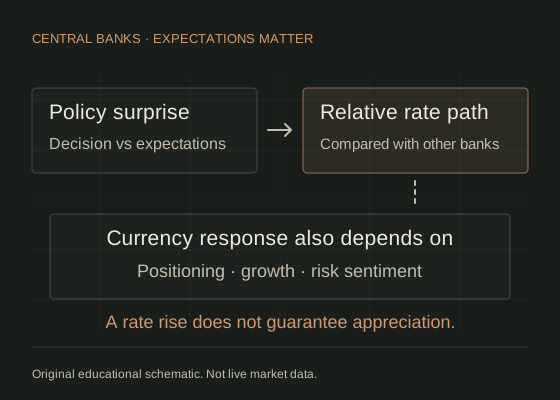
Start with both sides of the pair.
EUR/USD measures US dollars per euro. If the quote falls from a hypothetical 1.1000 to 1.0800, one euro buys fewer dollars: the euro has weakened relative to the dollar. That observation alone does not identify a single cause. Euro news, dollar news or a combination can alter the relative price.
The change in the EUR/USD quote is (1.0800 ÷ 1.1000 − 1) × 100, approximately −1.82%. Avoid describing that automatically as a fall against every currency. A currency can weaken against one counterpart while strengthening against another.
Reserve Bank of Australia: exchange-rate drivers explains relative rates and other influences using the Australian dollar. The general framework is useful, but Australia’s commodity exposure should not be copied unchanged to every economy or currency regime.
How policy reaches financial conditions.
A central bank can influence short-term financing conditions through its policy instruments and communicate its assessment of the economy. Those decisions and expectations about future decisions can affect a wider range of yields, borrowing costs and asset prices. The exchange rate is one possible transmission channel.
Bank of England: how monetary policy transmits discusses that transmission rather than promising a fixed currency response. Policy does not operate alone. A higher nominal rate can coexist with weak growth, elevated inflation or an increased risk premium. Comparing only two headline policy rates ignores their expected paths and economic context.
The Federal Reserve: the Federal Open Market Committee describes the US policy committee. Other central banks have their own mandates, instruments and communication schedules. Read the institution’s actual statement instead of assuming every meeting follows the FOMC format.
Work through a relative-rate example.
Suppose economy A has a 5.00% policy rate and economy B has 3.00%. Their simple policy-rate difference is two percentage points. A then cuts to 4.75%, while B stays at 3.00%; the difference becomes 1.75 percentage points. It narrowed by 0.25 percentage point, or 25 basis points.
This arithmetic does not prove that A’s currency must fall when the decision arrives. If participants expected a larger cut to 4.50%, the actual 4.75% decision is a smaller easing than that stated expectation. A different communication about future policy could change the interpretation again.
These are hypothetical expectations and rates. A survey forecast, an analyst scenario and a market-implied measure are not identical evidence. Record which you use, its date and its horizon; do not invent a consensus after observing the price reaction.
Separate the new information from the old story.
Reserve Bank of Australia: expectations and exchange rates discusses how expectations about future economic conditions can be reflected in exchange rates. That makes the comparison important: what changed relative to the information already available? An unchanged policy rate can accompany different guidance, forecasts or perceived risks.
Keep the observation window explicit. The first seconds after a release can contain wider spreads and rapidly changing quotes. A later daily move can incorporate further news. Saying “the currency rose because of the decision” is a causal claim; a chart showing two events at similar times is not by itself proof.
Use the CPI and employment guides to distinguish matching release measures and revisions. Strong employment or high inflation can be interpreted differently depending on what policy response was expected beforehand.
Keep a broader set of drivers in view.
| Driver | Question to record | Common oversimplification |
|---|---|---|
| Growth and inflation | How did the outlook change for each economy? | Treating every stronger release as automatically currency-positive. |
| Relative yields | Which maturity and expected policy path are being compared? | Comparing only current overnight policy rates. |
| Trade and commodity exposure | Which import or export prices matter to this economy? | Assigning the same commodity relationship to every currency. |
| Risk appetite and capital flows | Did demand for liquidity or risk change? | Assuming a historical safe-haven relationship holds in every episode. |
| Intervention and currency regime | Is the exchange rate floating, managed or constrained? | Applying a free-floating model to every exchange rate. |
These influences can conflict, and their importance can change by period. Adding more arrows to a narrative is not the same as testing explanatory power. Preserve an “uncertain” category instead of forcing every movement into one convenient cause.
Build a two-currency event note.
- Name the pair and define what a rise in its quote means.
- Record the next relevant releases for both economies using the calendar and official institution schedules.
- Write the prior value, matching expectation and scenario before the announcement.
- Afterwards, record the actual figures, revisions and statement changes separately.
- Log the observed quote window and execution conditions without claiming the reaction was predictable.
Repeat this on historical observations or paper notes before using it for any trade research. A useful explanation should state the data source and what would contradict the interpretation. It does not need to produce a trade every time new information arrives.
Common currency-driver questions.
Does a rate increase always strengthen the currency?
No. Relative expectations, guidance, inflation, risk conditions and the other currency’s outlook can change the reaction.
Are high policy rates the same as high real returns?
No. Inflation expectations, horizon, instrument risk, fees and currency changes affect the comparison. A nominal policy rate is only one input.
Can I explain a pair by following only one central bank?
That leaves out the other side of the relative price. Track relevant conditions for both currencies.
Sources & assumptions.
Prepared by InsomniCapital; see our editorial approach. Sources checked on 2 October 2026. Schematics and hypothetical calculations are labelled educational illustrations. Historical observations identify their source, dates and method separately. Neither is a live quote, trade recommendation or reported trading result.
- Reserve Bank of Australia: exchange-rate drivers.
- Bank of England: how monetary policy transmits.
- Reserve Bank of Australia: expectations and exchange rates.
- Federal Reserve: the Federal Open Market Committee.
Educational information only, not personalised investment advice. Leveraged trading carries a high risk of loss. Read our risk disclosure. InsomniCapital has an Axi affiliate relationship and may receive compensation for qualifying referrals. References are not endorsements of this guide.