Trading education · Economic events
How to Read Central Bank Decisions: Rates, Guidance and Minutes
Read central bank announcements step by step: compare expectations, rate decisions, statements, projections, press conferences and later meeting records.
The short answer
A central bank announcement is a set of documents and communications with different publication times. Compare the decision with expectations recorded beforehand, then inspect the statement, projections and explanations. A rate change alone does not determine a currency’s response.
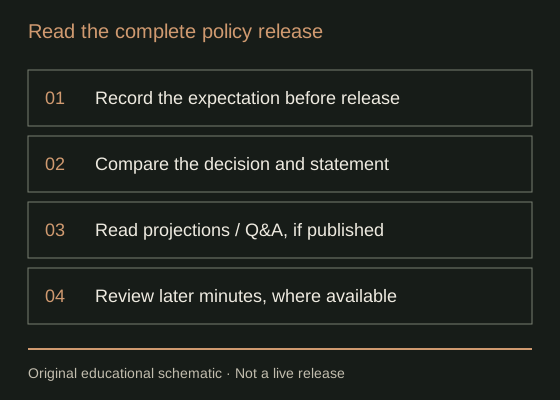
Identify the release before interpreting the headline.
This guide is a workflow for reading a particular policy announcement. The currency-driver guide explains the broader economic relationships; here the task is to establish which document changed, when it became available and how it differs from the previous version.
Record the institution, meeting date, policy instrument and official source. A target range, administered rate and asset-purchase decision are different objects. An unchanged headline rate does not prove that every operational setting or communication stayed unchanged.
Use the economic-events hub and calendar to organise the review, then confirm the actual publication details on the bank’s website. Distinguish the decision release, any press conference and later records. Check the stated time zone again around daylight-saving changes.
Use the institution’s own document sequence.
| Institution | What to open | Important distinction |
|---|---|---|
| Federal Reserve | Federal Reserve: meeting calendars, statements, projections and minutes; statement and implementation material. | Projection materials accompany designated meetings; minutes are a later release. |
| European Central Bank | ECB: monetary policy decisions and associated statement/Q&A. | The ECB: monetary policy accounts and related documents provide a later discussion record. |
| Bank of England | Bank of England: MPC summaries, minutes and report dates | The Monetary Policy Summary and minutes are published together; reports accompany designated meetings. |
| Bank of Japan | Bank of Japan: statements, Outlook Reports, opinions and minutes | Policy statements, Outlook Reports, Summary of Opinions and minutes are distinct publications. |
Do not impose the Fed’s sequence on every institution. In particular, “minutes” does not universally mean information first released weeks after a decision. The bank’s current calendar takes precedence over a saved timetable or a generic market-news label.
Save the comparison baseline beforehand.
Keep the previous decision and statement alongside a dated expectations note. Name the source of any consensus forecast, its collection time and the precise policy measure it forecasts. A survey median is not a probability distribution, and a market-implied estimate can depend on instrument conventions and modelling assumptions.
Write separate questions for the immediate decision and the possible future path. For example: was a rate change expected, was balance-sheet policy expected to change, and what conditions were previously attached to further action? Mark an unavailable forecast as unavailable instead of reconstructing one from the later price move.
Also record the instrument you are observing, quote source and review interval. This prevents a later screenshot from replacing the original information set. It does not establish that the source was executable or that the review interval has a trading advantage.
Measure a rate surprise in basis points.
Consider a hypothetical single policy rate previously at 3.50%, with a recorded forecast of 3.25%. The following invented outcomes illustrate two different comparisons; none is a current rate or prediction.
| Actual decision | Change from prior 3.50% | Difference from forecast 3.25% |
|---|---|---|
| 3.25% | −25 basis points | 0 basis points |
| 3.50% | 0 basis points | +25 basis points |
The cut from 3.50% to 3.25% is a fall of 0.25 percentage points, or 25 basis points. It matches the stated forecast. Holding at 3.50% makes no change to the rate but leaves it 25 basis points above that forecast. Neither comparison tells you the currency’s subsequent direction.
For a target range, compare like-for-like lower and upper bounds, or an explicitly defined midpoint. Do not compare yesterday’s upper bound with today’s midpoint and call the difference a policy surprise.
Read what changed in the statement.
Compare the new and previous wording in context. Separate the action taken now from descriptions of inflation, employment, activity and risks. Then identify the conditions attached to future decisions. A conditional statement about what policymakers would do under one scenario is not a commitment that the scenario will occur.
Record a short paraphrase and a link to the relevant passage. Keep your interpretation in a separate column: “the statement changed this phrase” is an observation; “this implies a faster easing path” is an inference requiring support.
A label such as hawkish or dovish needs a comparison baseline. The same wording can be interpreted differently against different expectations. Reading only the rate number or one extracted adjective loses the surrounding qualification.
Check projections and questions without merging them.
The Federal Reserve: the Summary of Economic Projections summarises participants’ economic and policy-rate projections. Those submissions should not be presented as a single guaranteed committee rate path. Check the projection horizon, measure, uncertainty and assumptions before comparing changes across releases.
Other banks publish their own outlooks or forecast materials, with different conventions. Confirm whether fresh projections actually accompany this meeting. An older report linked beside a new statement is still older information.
Where a press conference occurs, distinguish the prepared explanation from later answers. Record the time and question that prompted an answer, and verify a short quotation against the official transcript or recording. A qualification added in discussion can change the interpretation of an isolated headline.
Review later records as later information.
Open minutes, accounts or a Summary of Opinions under their actual publication date. They describe an earlier meeting and may arrive after additional economic releases. Preserve both dates so later details do not leak into a backtest of the original announcement.
Finish a review with three columns: confirmed changes, remaining uncertainties and observations that would challenge your interpretation. Compare the initial response with a later preselected interval, while allowing for other news and the other currency in the pair.
If execution is part of a separate plan, inspect spread and slippage assumptions and order handling. A complete release review can lead to further observation or no trade. It is not an instruction to enter during the announcement.
Common policy-announcement questions.
Why can a currency move when the policy rate is unchanged?
An unchanged rate can differ from expectations, while guidance, projections or operational decisions can also change. Other news may contribute. The rate headline alone cannot explain the observed move.
Are meeting minutes always a later release?
No. Publication conventions differ. The Bank of England publishes its Monetary Policy Summary and minutes together. Check the institution’s own schedule and the specific document’s publication date.
Can I reconstruct the forecast after seeing the result?
That would introduce hindsight into the comparison. Use a dated forecast recorded before the release, or mark it unavailable. A later price reaction is not evidence of the original consensus.
Sources & assumptions.
Prepared by InsomniCapital; see our editorial approach. Sources checked on 2 October 2026. Schematics and hypothetical calculations are labelled educational illustrations. Historical observations identify their source, dates and method separately. Neither is a live quote, trade recommendation or reported trading result.
- Federal Reserve: meeting calendars, statements, projections and minutes.
- Federal Reserve: the Summary of Economic Projections.
- ECB: monetary policy decisions.
- ECB: monetary policy accounts and related documents.
- Bank of England: MPC summaries, minutes and report dates.
- Bank of Japan: statements, Outlook Reports, opinions and minutes.
Educational information only, not personalised investment advice. Leveraged trading carries a high risk of loss. Read our risk disclosure. InsomniCapital has an Axi affiliate relationship and may receive compensation for qualifying referrals. References are not endorsements of this guide.