Trading education · Gold trading
Gold Trading for Beginners: XAU/USD, Drivers and Risk
Understand XAU/USD, compare gold CFDs, futures and physical exposure, and prepare a trade using contract size, costs, price drivers and risk calculations.
Explore the guide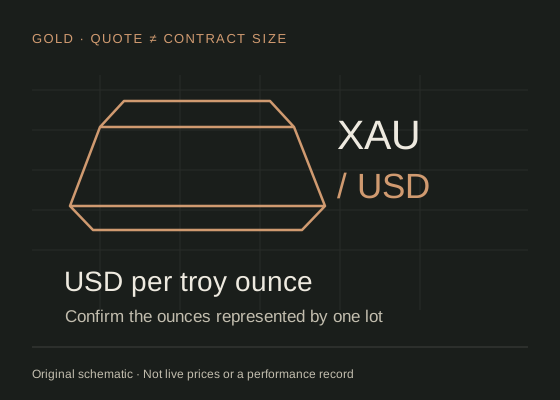
The short answer
XAU/USD expresses a gold price in US dollars per troy ounce. The symbol alone does not identify the legal product or contract size. Before considering a method, understand what you would hold, how gains and losses are calculated, and the costs and leverage involved.
What XAU/USD means.
XAU is the market code used for gold; USD identifies the US dollar quote currency. A displayed price of 2,400 in this guide means USD 2,400 per troy ounce in a hypothetical example. It is not a current price or a statement that every instrument called XAU/USD has identical terms.
A broker's rolling spot gold CFD, an exchange-traded futures contract and physical bullion create different rights and obligations. Buying a CFD does not deliver a bar of gold. Buying shares in a gold-related fund is also not equivalent to holding a leveraged gold contract.
Start with the actual product specification: quote units, contract size, minimum quantity, size increment, margin, trading hours and charges. Our 0.01-lot gold guide explains why the contract size must come before the cash-risk calculation.
Compare the route to gold exposure.
| Route | What to understand | Costs or operational details |
|---|---|---|
| Physical bullion | Ownership, custody, authenticity and resale arrangements. | Dealer premium, bid/ask difference, storage and insurance. |
| Gold-backed fund or similar security | The fund mandate, backing, legal structure and tracking. | Fund charges, brokerage, trading hours and possible tracking differences. |
| Gold futures | Exchange contract, expiry, settlement and margin obligations. | Commission, spread, variation margin, expiry and rollover handling. |
| Gold CFD / rolling spot derivative | A contract with the provider, usually with leveraged exposure. | Spread, possible commission and overnight financing; provider-specific protections. |
CME Group: gold futures contract family lists multiple contract sizes. Do not copy a futures contract size into a CFD calculator simply because both reference gold. Availability and investor protections differ by country, account and provider.
Understand the drivers without inventing a rule.
World Gold Council: factors influencing gold discusses currencies, interest rates, inflation, demand, risk and supply. These influences interact. A stronger dollar can make dollar-priced gold more expensive in other currencies, while changes in real yields can alter the opportunity cost of holding an asset that does not pay interest. Neither relationship guarantees the direction of a particular session.
Physical demand, investment flows, central-bank activity and risk aversion can matter on different horizons. A headline labelled “good for gold” can coincide with a falling price if it was already expected or another influence dominates.
For a practical reading exercise, write two competing explanations before checking the next price move. For example, an inflation surprise may raise demand for an inflation hedge while also raising expected interest rates. The exercise helps prevent attaching a confident single cause to every candle after the event.
Translate a price move into cash.
Assume a hypothetical linear contract of 100 troy ounces per lot. A 0.10-lot position represents 10 ounces. A USD 10 adverse move per ounce therefore models USD 100 of price loss before other costs.
If a long enters at 2,400 and has a stop at 2,390, the intended distance is USD 10 per ounce. A gap or slippage can produce a worse fill. If the account is in GBP, the USD result also needs conversion using an explicitly stated rate and any applicable charges.
Margin is separate. With exposure of USD 24,000 and a hypothetical 5% margin requirement, the required margin would be USD 1,200. That amount is neither the planned stop loss nor a cap on the position's potential loss.
Use the gold position-size calculator and gold profit-and-loss examples to check the arithmetic against your symbol specification. A calculator cannot establish whether a trade is suitable or worthwhile.
Study methods with explicit limits.
A trend-following method asks whether an existing move persists. A range method asks whether a bounded area continues to hold. A breakout method asks whether price continues beyond a prior boundary. They make different assumptions and fail under different conditions.
Reusing a forex setup on gold requires more than changing the symbol. Test the price increments, dealing breaks, typical cost relative to the planned stop, and data source. A gold “pip” label may mean different things on different platforms, which is why our gold calculator uses actual price distances.
None of the educational examples establishes a profitable gold strategy. Keep the instrument, period, costs and execution model explicit when evaluating any method.
A preparation sequence for a beginner.
- Identify the product and verify its provider and contract specification.
- Practise order entry and cancellation in a demo environment, including protective orders.
- Check dealing hours, daily breaks and the economic calendar.
- Record a hypothetical entry, invalidation and exit before measuring position size.
- Estimate spread, financing and conversion costs, then review margin separately.
- Keep a journal of intended versus simulated fills, including losing examples.
Demo trading can help learn a platform, but it does not reproduce every live execution condition or establish future results. Avoid increasing size simply because a short practice sample was favourable.
Common beginner gold questions.
Is gold safer than forex?
The label does not determine the risk. Product structure, leverage, position size, liquidity and execution matter. A leveraged gold position can lose money quickly.
Is one gold lot always 100 ounces?
No. That is the explicit assumption in our worked CFD examples. Confirm the specific product; futures and provider contracts can have different sizes.
What news should I understand first?
Start with US CPI, the US jobs report and FOMC decisions. They are relevant context, not mechanical gold buy/sell instructions.
Sources & assumptions.
Prepared by InsomniCapital; see our editorial approach. Sources checked on 2 October 2026. Schematics and hypothetical calculations are labelled educational illustrations. Historical observations identify their source, dates and method separately. Neither is a live quote, trade recommendation or reported trading result.
- World Gold Council: factors influencing gold.
- CME Group: gold futures contract family.
- Investor.gov: order execution risks (securities examples).
Educational information only, not personalised investment advice. Leveraged trading carries a high risk of loss. Read our risk disclosure. InsomniCapital has an Axi affiliate relationship and may receive compensation for qualifying referrals. References are not endorsements of this guide.