Trading education · Trading styles
Day Trading vs Swing Trading vs Scalping
Compare scalping, day trading and swing trading by holding period, screen time, execution costs, overnight exposure and practical learning requirements.
In this lesson
- Compare holding periods and monitoring demands.
- Explain why the same cost can matter more to a smaller planned move.
Course outline
The complete course
8 modules. One clear path.
Follow the lessons in order, or return to a topic when you need it. Every lesson is open.
01Market foundations7 lessons · Not started
Start with quotes, orders, costs, exposure and the practical demands of a trading day.
- Read a currency quoteNot completed
- Choose an order instructionNot completed
- Identify the costs of executionNot completed
- Separate margin from riskNot completed
- Read account equity and closeout rulesNot completed
- Compare styles and commitmentsNot completed
- Read session times correctlyNot completed
02Stops, sizing and risk6 lessons · Not started
Connect price distances and contract assumptions to cash exposure, payoff and drawdown.
- Measure a stop distanceNot completed
- Calculate a position sizeNot completed
- Convert JPY pip valuesNot completed
- Include costs consistentlyNot completed
- Separate payoff from expectancyNot completed
- Understand recovery and loss sequencesNot completed
03Read price in context4 lessons · Not started
Work from completed observations to candles, zones and clearly stated pattern boundaries.
- Describe swings without hindsightNot completed
- Read the candle before the labelNot completed
- Mark and test a price zoneNot completed
- Define a chart pattern’s boundaryNot completed
04Understand indicator calculations3 lessons · Not started
Study what moving averages, RSI and MACD calculate before interpreting a signal.
- Compare SMA and EMANot completed
- Interpret RSI with its assumptionsNot completed
- Separate MACD from its histogramNot completed
05Gold products and calculations4 lessons · Not started
Identify the product, translate lots into ounces and work through results and position sizing.
- Identify the gold productNot completed
- Translate gold lots into ouncesNot completed
- Calculate a gold trade’s resultNot completed
- Translate gold lots into cash riskNot completed
06Economic releases and policy9 lessons · Not started
Read currency drivers, inflation, growth and policy announcements with their expectations and revisions.
- Study both sides of a currency pairNot completed
- Read an NFP releaseNot completed
- Compare like-for-like CPI figuresNot completed
- Compare PCE inflation measuresNot completed
- Read growth rates and revisionsNot completed
- Interpret a survey readingNot completed
- Separate spending from quantitiesNot completed
- Read the complete policy releaseNot completed
- Read beyond the FOMC headlineNot completed
07Build and test study rules5 lessons · Not started
Define a reproducible study, audit its assumptions and work through breakout, trend and range examples.
- Write a complete study specificationNot completed
- Audit a backtest before trusting itNot completed
- Account for a breakout’s executionNot completed
- Specify a trend-following studyNot completed
- Specify a range-trading studyNot completed
08Review decisions and evidence2 lessons · Not started
Review the process behind a result and the records needed to assess a performance claim.
- Review decisions as well as outcomesNot completed
- Assess signals and performance claimsNot completed
The short answer
A trading style describes the intended holding horizon and workflow. Scalping generally targets very short moves, day trading closes within the chosen session, and swing trading holds across sessions. A shorter holding period does not automatically mean lower risk or easier profits.
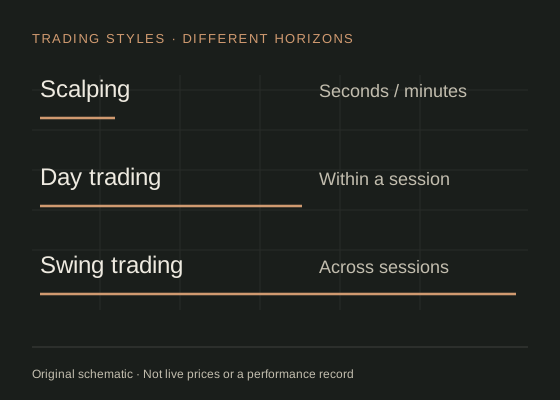
Compare the work, not just the holding time.
IG: trading styles and holding periods distinguishes approaches by their usual holding periods. In practice, labels overlap: a scalper can be a day trader, while a swing trader might occasionally exit within the same day. The planned process matters more than the label.
| Style | Usual horizon | Attention and practical friction |
|---|---|---|
| Scalping | Seconds to minutes. | Continuous attention while active; small intended moves make spread, commission and latency consequential. |
| Day trading | Minutes to hours within a defined session. | Scheduled preparation and monitoring; a written end-of-session exit prevents accidental overnight exposure. |
| Swing trading | Several sessions, often days to weeks. | Less frequent decisions can still require monitoring; overnight gaps, financing and event exposure need planning. |
A lower number of trades does not eliminate work. A swing plan still needs position review, event awareness and order management. A high number of trades does not demonstrate skill; it creates more execution decisions and more opportunities to incur costs.
See how the same cost changes a small target.
Assume a hypothetical EUR/USD position whose pip value is USD 1. A combined round-trip cost model of 1.2 pips represents USD 1.20. For an intended 4-pip gross winning move, that leaves USD 2.80 before any other costs. For a 40-pip gross move at the same size, it leaves USD 38.80.
The cost consumes 30% of the first gross winning move and 3% of the second. This comparison does not prove swing trading is better: the stop, time held, win frequency and overnight costs can differ. It shows why cost relative to the planned move matters.
Keep spread accounting consistent. If entry and exit already use executable ask and bid prices, their difference already includes the spread. Do not subtract the same spread again. See the cost guide for the distinction between price assumptions and additional charges.
Each style has a different risk schedule.
A day trader who is flat overnight avoids price exposure during that particular holding window, but can still suffer slippage or a large intraday loss. A swing trader accepts more event windows and possible reopening gaps while holding. A scalper's small nominal stop can be large relative to the available spread or ordinary price noise.
Trading correlated pairs can also concentrate exposure. Three small positions expressing the same dollar view are not automatically three independent risks. Review the portfolio as well as each ticket.
Check the instrument's financing and dealing terms instead of assuming all products have the same rollover convention. Futures, CFDs and securities have different structures; global readers should also check the rules applying to their own account rather than transplanting another jurisdiction's account restrictions.
Build a realistic practice schedule.
Start with the time you can reliably devote to preparation and review. If you cannot monitor quotes continuously, an exercise that depends on second-by-second reaction is not compatible with your schedule. That is an operational mismatch, not a statement about your ability.
For an example day-trading practice session, allocate time before the session to check the calendar and mark relevant areas, restrict observations to a defined window, and review intended versus simulated fills afterwards. Set the stop time before starting.
For a swing-trading exercise, define fixed review times and the conditions requiring an unscheduled review. Record financing assumptions and events occurring while a hypothetical position remains open. Avoid describing the workflow as passive merely because it uses a daily chart.
Choose a reproducible exercise before risking money.
Test one workflow in a demo or observation journal. Keep its rules stable long enough to see awkward cases: missed entries, unavailable quotes, losing streaks and interruptions. A few favourable outcomes are too little evidence to infer a reliable edge.
- Can you follow the plan with the time and equipment you actually have?
- Can you explain each order and its failure mode?
- Are costs small enough relative to the planned distances to justify further study?
- Can you stop at the planned time without turning a short trade into an unplanned longer one?
- Have you recorded unfavourable examples as carefully as favourable ones?
Use the strategy overview to separate a style from an entry/exit method. Scalping is a holding-horizon description; it does not specify what to buy, when to exit or why the process should work.
Work through it yourself.
Record the plan, execution assumptions, outcome and lessons from a practice trade.
Download trading-review worksheet PDF · 2 pagesFree to download without registering. Practice examples explain the method; they do not establish a profitable strategy.
Common trading-style questions.
Which style is best for beginners?
No style is universally suitable. Begin with product mechanics, a realistic schedule and controlled practice. Compare complete workflows rather than promises of daily income.
Is swing trading less risky because there are fewer trades?
Fewer transactions may reduce some costs, but longer holding periods introduce different exposures. Position size, gaps, financing and the complete exit rule still matter.
Can a losing day trade become a swing trade?
Changing the label does not repair the loss. Extending a position beyond its original horizon changes the risk assumptions and should not be an improvised substitute for the planned exit.
Sources & assumptions.
Prepared by InsomniCapital; see our editorial approach. Sources checked on 2 October 2026. Schematics and hypothetical calculations are labelled educational illustrations. Historical observations identify their source, dates and method separately. Neither is a live quote, trade recommendation or reported trading result.
- IG: trading styles and holding periods.
- Investor.gov: order execution risks (securities examples).
- CME Group: chart types and OHLC data.
Educational information only, not personalised investment advice. Leveraged trading carries a high risk of loss. Read our risk disclosure. InsomniCapital has an Axi affiliate relationship and may receive compensation for qualifying referrals. References are not endorsements of this guide.
Lesson 6 checkpoint
Put the reading into practice
Work it through
Compare a hypothetical five-pip move and a fifty-pip move with the same one-pip round-trip cost. Record the cost as a percentage of each gross move.
Completion records your study of this lesson. Read the evidence standards for how examples and claims are presented.