Trading education · The foundations
Forex trading
for beginners.
Learn what a currency quote means, what an order actually does, and how a small price move becomes a cash gain or loss.
In this lesson
- Identify the base and quote currencies.
- Distinguish a pip from a smaller display increment.
Course outline
The complete course
8 modules. One clear path.
Follow the lessons in order, or return to a topic when you need it. Every lesson is open.
01Market foundations7 lessons · Not started
Start with quotes, orders, costs, exposure and the practical demands of a trading day.
- Read a currency quoteNot completed
- Choose an order instructionNot completed
- Identify the costs of executionNot completed
- Separate margin from riskNot completed
- Read account equity and closeout rulesNot completed
- Compare styles and commitmentsNot completed
- Read session times correctlyNot completed
02Stops, sizing and risk6 lessons · Not started
Connect price distances and contract assumptions to cash exposure, payoff and drawdown.
- Measure a stop distanceNot completed
- Calculate a position sizeNot completed
- Convert JPY pip valuesNot completed
- Include costs consistentlyNot completed
- Separate payoff from expectancyNot completed
- Understand recovery and loss sequencesNot completed
03Read price in context4 lessons · Not started
Work from completed observations to candles, zones and clearly stated pattern boundaries.
- Describe swings without hindsightNot completed
- Read the candle before the labelNot completed
- Mark and test a price zoneNot completed
- Define a chart pattern’s boundaryNot completed
04Understand indicator calculations3 lessons · Not started
Study what moving averages, RSI and MACD calculate before interpreting a signal.
- Compare SMA and EMANot completed
- Interpret RSI with its assumptionsNot completed
- Separate MACD from its histogramNot completed
05Gold products and calculations4 lessons · Not started
Identify the product, translate lots into ounces and work through results and position sizing.
- Identify the gold productNot completed
- Translate gold lots into ouncesNot completed
- Calculate a gold trade’s resultNot completed
- Translate gold lots into cash riskNot completed
06Economic releases and policy9 lessons · Not started
Read currency drivers, inflation, growth and policy announcements with their expectations and revisions.
- Study both sides of a currency pairNot completed
- Read an NFP releaseNot completed
- Compare like-for-like CPI figuresNot completed
- Compare PCE inflation measuresNot completed
- Read growth rates and revisionsNot completed
- Interpret a survey readingNot completed
- Separate spending from quantitiesNot completed
- Read the complete policy releaseNot completed
- Read beyond the FOMC headlineNot completed
07Build and test study rules5 lessons · Not started
Define a reproducible study, audit its assumptions and work through breakout, trend and range examples.
- Write a complete study specificationNot completed
- Audit a backtest before trusting itNot completed
- Account for a breakout’s executionNot completed
- Specify a trend-following studyNot completed
- Specify a range-trading studyNot completed
08Review decisions and evidence2 lessons · Not started
Review the process behind a result and the records needed to assess a performance claim.
- Review decisions as well as outcomesNot completed
- Assess signals and performance claimsNot completed
The short answer
Forex trading involves exposure to changes in currency exchange rates. Before considering a trade, understand the product, position size, total costs and how the position could lose money. A demo account can teach mechanics; it cannot prove future live performance.
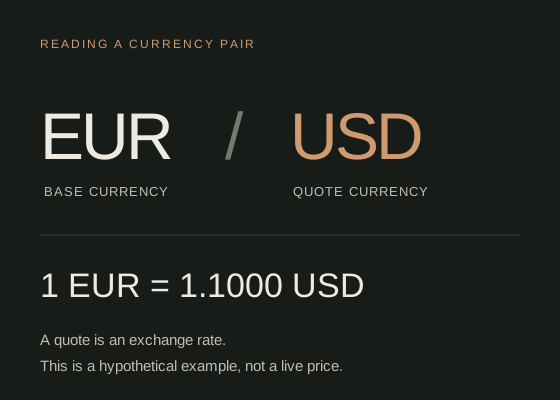
Read the quote before the chart.
In EUR/USD, EUR is the base currency and USD is the quote currency. A price of 1.1000 expresses US$1.10 per euro. Buying the pair gives exposure to the euro rising against the dollar; selling gives exposure to the opposite move. The product you trade may be a rolling spot contract or CFD rather than delivery of currency.
Suppose you buy exposure to 10,000 EUR at 1.1000 and close at 1.1020. The price difference is US$0.0020 per euro, so the gross gain is 10,000 × 0.0020 = US$20. Closing at 1.0980 instead gives a US$20 gross loss. These examples exclude costs and assume execution at the stated prices.
If your account currency is not USD, the result also needs conversion. Product availability and protections vary by jurisdiction and broker. Read the specification for the actual account you intend to use.
Pips measure movement. Lots measure size.
For EUR/USD, one pip is 0.0001. A change from 1.1000 to 1.1020 is 20 pips. A fifth decimal is a fraction of a pip; it is not another full pip. Many yen pairs use 0.01 instead, so the convention must match the instrument.
With the standard EUR/USD definition of 100,000 EUR per lot, 0.10 lot represents 10,000 EUR. Each pip on that 0.10-lot example is worth US$1 before costs and conversion. Doubling the size doubles the cash impact of the same price movement.
Original worked example
10,000 EUR × 0.0001 USD/EUR = US$1 per pip
Follow the position-size calculation before using any lot number. Gold uses a different contract definition; see the XAU/USD guide.
The chart price is not your complete trading cost.
A platform usually shows a bid and an ask. A buyer enters at the ask and closes at the bid; a seller does the reverse. The gap between them is the spread. Some chart views display only one side or a midpoint.
Imagine an unchanged EUR/USD quote of 1.1000 bid / 1.1002 ask. Buying 10,000 EUR at the ask and immediately selling at the bid would lose US$2 from the spread alone. This is an arithmetic illustration, not a typical-spread claim.
Commission, overnight financing and currency conversion may add costs. Slippage means execution differs from the expected price. Record actual entry and exit prices and charges; do not subtract the spread twice if it is already captured in your fills.
Know what your order asks the broker to do.
| Order | Purpose | Limitation |
|---|---|---|
| Market | Request execution at the available market price. | The price can change before execution. |
| Limit | Request a specified price or better. | The order may never fill. |
| Stop | Trigger an action when the stop level is reached. | An ordinary stop does not guarantee the exit price. |
A stop entry and a protective stop loss serve different purposes. Check the order direction, trigger price, size and expiry on the ticket. Understand which bid or ask triggers the order. Practise cancellation and modification on a demo account before relying on those controls.
Separate margin from money at risk.
Margin is collateral required to support a position. It is not a maximum loss. Leverage expresses the relationship between exposure and that collateral. For a fixed position size, changing leverage does not change the cash value of the same price move.
In a simplified example, US$10,000 of exposure at 20:1 leverage requires US$500 of initial margin. A 1% adverse move in that exposure represents a US$100 loss before costs—20% of the initial margin. Real brokers may use tiered requirements, currency conversion and closeout rules.
Plan the loss scenario first: account amount, chosen cash budget, entry-to-stop distance, costs and size. Consider other open trades as well. Two positions that both depend on a stronger dollar can concentrate the same underlying risk.
Practise the mechanics before moving on.
- Check the product: record the symbol, contract size, quote currency and dealing hours.
- Use a demo ticket: practise entering, cancelling and closing an order, including changes to a stop.
- Check your workings: reproduce a hypothetical loss calculation by hand, then compare the calculator.
- Keep a journal: record assumptions, mistakes, losing examples and skipped trades as well as successful examples.
Next, study market, limit and stop orders. Follow the course map through the remaining lessons, including margin and leverage, position sizing and risk.
There is no deadline to move to live trading. Understanding the interface does not establish that a strategy will make money.
Common questions.
How much money should a beginner start with?
There is no universally suitable amount. Minimum deposits, minimum position sizes, disposable funds and personal circumstances differ. A small deposit does not make leveraged trading low risk.
Does a profitable demo account prove a strategy works?
No. Demo execution, emotional pressure and available liquidity can differ from live trading. A short profitable period can also occur by chance.
Can signals replace learning these basics?
No. You still control the account and need to understand size, execution and losses. Read how to evaluate a signal before treating an alert as a decision.
Sources & assumptions.
Prepared by InsomniCapital; see our editorial approach. Sources checked on 2 October 2026. Schematics and hypothetical calculations are labelled educational illustrations. Historical observations identify their source, dates and method separately. Neither is a live quote, trade recommendation or reported trading result.
- FOREX.com: currency-pair and forex-market mechanics.
- OANDA: pip and fractional-pip conventions.
- OANDA: margin, leverage and stop limitations.
- Investor.gov: general order concepts (securities examples; forex execution rules differ).
Educational information only, not personalised investment advice. Leveraged trading carries a high risk of loss. Read our risk disclosure. InsomniCapital has an Axi affiliate relationship and may receive compensation for qualifying referrals. References are not endorsements of this guide.
Lesson 1 checkpoint
Put the reading into practice
Work it through
Write what one unit of EUR/USD represents. Then calculate the pip change from 1.1000 to 1.1025 using a pip size of 0.0001.
Completion records your study of this lesson. Read the evidence standards for how examples and claims are presented.