Trading education · Risk management
How to calculate
gold position size.
A dollar move in gold is not a forex pip. Start with troy ounces per lot, then translate the stop distance into cash risk.
In this lesson
- Convert a price move into loss per lot using stated ounces.
- Reserve costs and apply the permitted size increment.
Course outline
The complete course
8 modules. One clear path.
Follow the lessons in order, or return to a topic when you need it. Every lesson is open.
01Market foundations7 lessons · Not started
Start with quotes, orders, costs, exposure and the practical demands of a trading day.
- Read a currency quoteNot completed
- Choose an order instructionNot completed
- Identify the costs of executionNot completed
- Separate margin from riskNot completed
- Read account equity and closeout rulesNot completed
- Compare styles and commitmentsNot completed
- Read session times correctlyNot completed
02Stops, sizing and risk6 lessons · Not started
Connect price distances and contract assumptions to cash exposure, payoff and drawdown.
- Measure a stop distanceNot completed
- Calculate a position sizeNot completed
- Convert JPY pip valuesNot completed
- Include costs consistentlyNot completed
- Separate payoff from expectancyNot completed
- Understand recovery and loss sequencesNot completed
03Read price in context4 lessons · Not started
Work from completed observations to candles, zones and clearly stated pattern boundaries.
- Describe swings without hindsightNot completed
- Read the candle before the labelNot completed
- Mark and test a price zoneNot completed
- Define a chart pattern’s boundaryNot completed
04Understand indicator calculations3 lessons · Not started
Study what moving averages, RSI and MACD calculate before interpreting a signal.
- Compare SMA and EMANot completed
- Interpret RSI with its assumptionsNot completed
- Separate MACD from its histogramNot completed
05Gold products and calculations4 lessons · Not started
Identify the product, translate lots into ounces and work through results and position sizing.
- Identify the gold productNot completed
- Translate gold lots into ouncesNot completed
- Calculate a gold trade’s resultNot completed
- Translate gold lots into cash riskNot completed
06Economic releases and policy9 lessons · Not started
Read currency drivers, inflation, growth and policy announcements with their expectations and revisions.
- Study both sides of a currency pairNot completed
- Read an NFP releaseNot completed
- Compare like-for-like CPI figuresNot completed
- Compare PCE inflation measuresNot completed
- Read growth rates and revisionsNot completed
- Interpret a survey readingNot completed
- Separate spending from quantitiesNot completed
- Read the complete policy releaseNot completed
- Read beyond the FOMC headlineNot completed
07Build and test study rules5 lessons · Not started
Define a reproducible study, audit its assumptions and work through breakout, trend and range examples.
- Write a complete study specificationNot completed
- Audit a backtest before trusting itNot completed
- Account for a breakout’s executionNot completed
- Specify a trend-following studyNot completed
- Specify a range-trading studyNot completed
08Review decisions and evidence2 lessons · Not started
Review the process behind a result and the records needed to assess a performance claim.
- Review decisions as well as outcomesNot completed
- Assess signals and performance claimsNot completed
The short answer
Gold lots = available price-risk budget ÷ (entry-to-stop distance × troy ounces per lot), with currency conversion where needed. Round down to a permitted lot increment and check the minimum. An ordinary stop cannot guarantee the modelled loss.
Read the gold contract first.
XAU/USD quotes gold in US dollars per troy ounce. Axi’s referenced gold CFD specification lists 100 ounces per lot, but that is a product example rather than a universal rule. Check your own broker, account, symbol and jurisdiction.
At 100 ounces per lot, a US$1 move per ounce changes a one-lot position by US$100 before costs. At 0.10 lot, it changes the position by US$10. Calling a move “ten pips” is not enough: gold pip and point labels vary between platforms. This calculator uses actual entry and stop prices instead.
This tool models a linear, USD-quoted gold contract sized in lots. It does not model futures contracts, options, ETFs, spread-betting stakes or physical ownership.
An annotated gold contract specification.
The specimen below shows how to read the fields used in a sizing calculation. It is an invented linear XAU/USD contract for education, not a screenshot or a current specification from Axi or another broker. Confirm the actual symbol, account and provider before using any value.
Illustrative specification · XAU/USD
Translate each field into a calculation.
- 01 / Quote unit
- USD per troy ounceA change from 2,400.00 to 2,402.50 is USD 2.50 per ounce, not USD 2.50 for every position.
- 02 / Contract size
- 100 troy ounces per lot0.05 lot represents 5 ounces. Multiply price distance by those ounces to calculate the gross cash change.
- 03 / Minimum price increment
- USD 0.01 per ounceOne tick changes a full lot by USD 1; at 0.05 lot it changes the position by USD 0.05. A tick is not a universal gold pip.
- 04 / Minimum and size increment
- Minimum 0.01 lot; steps of 0.01 lotA calculated 0.057 lot rounds down to 0.05. A calculated 0.008 is below the minimum; rounding it up would exceed the modelled budget.
- 05 / Commission convention
- USD 7 per full lot, round turnAt 0.05 lot, opening and closing together cost USD 0.35 under this proportional-fee assumption. A per-side quote would need both sides counted.
Combine the specimen fields: a USD 2.50 adverse move on 0.05 lot produces 2.50 × 5 = USD 12.50 of price loss. Add USD 0.35 commission for a USD 12.85 total under the stated assumptions. This example excludes financing and slippage and assumes the price difference already reflects the executable quote sides.
Margin, maximum volume, stop-distance restrictions and dealing hours are separate checks. These example fields alone do not establish that a broker will accept or fill an order.
Work through one position by hand.
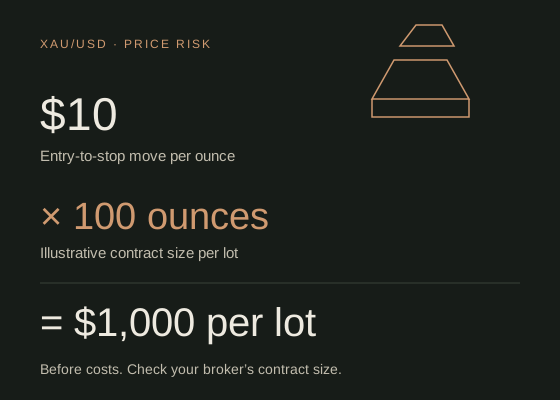
Take a hypothetical USD 10,000 account and a chosen 1% budget: USD 100. For a long example with entry at USD 2,400 per ounce and stop at USD 2,390, the distance is USD 10 per ounce. These prices and the risk percentage are illustrative, not live quotes or recommendations.
No-cost example, 100 ounces per lot
Loss per lot = 10 × 100 = USD 1,000
Position = 100 ÷ 1,000 = 0.10 lot
That position represents 10 ounces. If you reserve USD 5 for costs, only USD 95 remains for the price move. At 0.01-lot increments the size becomes 0.09 lot, modelling USD 90 of price loss plus USD 5 reserved. Rounding to 0.10 would exceed that combined budget.
For a GBP 100 budget at an illustrative rate of USD 1.25 per pound, the same one-lot move is GBP 800. With no cost reserve, 100 ÷ 800 = 0.125 lot; rounding down to 0.01 increments gives 0.12 lot and GBP 96 of modelled price loss.
Calculate with your contract assumptions.
Prefer a focused workspace? Open the standalone calculator in Tools.
Replace the examples with the specification you want to examine. All money inputs except the entry and stop use your selected account currency. Inputs stay in your browser.
What can make the actual loss different?
- Execution. A long opens on the ask and exits on the bid; a short reverses those sides. Use the appropriate execution prices and avoid counting a spread twice.
- Slippage and gaps. An ordinary stop is not a guaranteed fill at the specified price.
- Costs. Commission, financing and conversion charges can depend on size and holding period. A fixed reserve is only an assumption; review it against the resulting size.
- Currency conversion. This model uses one manual USD-per-account-unit rate. The broker’s exit conversion may differ.
- Margin. Fitting the risk budget does not mean sufficient free margin exists.
- Contract changes. Minimum size, volume step, maximum size and contract units must match your product.
If the calculated amount is below the minimum, the result is zero. The tool will not round up to force a trade to fit. If the maximum is reached, it caps the result even if some risk budget remains unused.
Common questions.
How much does 0.01 lot of gold represent?
At 100 troy ounces per lot, 0.01 lot is one ounce of exposure. A USD 1 move then creates USD 1 of gross profit or loss. A different contract size changes that answer.
Can I use a short setup?
Yes. Select short and enter a stop above the entry. The model uses that adverse price distance; a stop on the wrong side is rejected.
Does this place an order?
No. It performs an educational calculation in your browser. It does not connect to a broker, fetch prices or confirm that a trade is permitted.
Sources & assumptions.
Prepared by InsomniCapital; see our editorial approach. Sources checked on 2 October 2026. Schematics and hypothetical calculations are labelled educational illustrations. Historical observations identify their source, dates and method separately. Neither is a live quote, trade recommendation or reported trading result.
Educational information only, not personalised investment advice. Leveraged trading carries a high risk of loss. Read our risk disclosure. InsomniCapital has an Axi affiliate relationship and may receive compensation for qualifying referrals. References are not endorsements of this guide.
Lesson 24 checkpoint
Put the reading into practice
Work it through
With an illustrative 100 ounces per lot and a USD 10-per-ounce stop distance, calculate loss per lot. Apply a USD 100 budget, USD 5 reserve and 0.01-lot increments.
Completion records your study of this lesson. Read the evidence standards for how examples and claims are presented.