Trading education · Economic releases
NFP Explained: Payrolls, Forecasts and Revisions
Learn what nonfarm payrolls measure, how NFP differs from unemployment, and how to read actual, forecast, wages and revisions on an economic calendar.
In this lesson
- Distinguish current payroll change, forecast and revisions.
- Keep payroll and unemployment measures conceptually separate.
Course outline
The complete course
8 modules. One clear path.
Follow the lessons in order, or return to a topic when you need it. Every lesson is open.
01Market foundations7 lessons · Not started
Start with quotes, orders, costs, exposure and the practical demands of a trading day.
- Read a currency quoteNot completed
- Choose an order instructionNot completed
- Identify the costs of executionNot completed
- Separate margin from riskNot completed
- Read account equity and closeout rulesNot completed
- Compare styles and commitmentsNot completed
- Read session times correctlyNot completed
02Stops, sizing and risk6 lessons · Not started
Connect price distances and contract assumptions to cash exposure, payoff and drawdown.
- Measure a stop distanceNot completed
- Calculate a position sizeNot completed
- Convert JPY pip valuesNot completed
- Include costs consistentlyNot completed
- Separate payoff from expectancyNot completed
- Understand recovery and loss sequencesNot completed
03Read price in context4 lessons · Not started
Work from completed observations to candles, zones and clearly stated pattern boundaries.
- Describe swings without hindsightNot completed
- Read the candle before the labelNot completed
- Mark and test a price zoneNot completed
- Define a chart pattern’s boundaryNot completed
04Understand indicator calculations3 lessons · Not started
Study what moving averages, RSI and MACD calculate before interpreting a signal.
- Compare SMA and EMANot completed
- Interpret RSI with its assumptionsNot completed
- Separate MACD from its histogramNot completed
05Gold products and calculations4 lessons · Not started
Identify the product, translate lots into ounces and work through results and position sizing.
- Identify the gold productNot completed
- Translate gold lots into ouncesNot completed
- Calculate a gold trade’s resultNot completed
- Translate gold lots into cash riskNot completed
06Economic releases and policy9 lessons · Not started
Read currency drivers, inflation, growth and policy announcements with their expectations and revisions.
- Study both sides of a currency pairNot completed
- Read an NFP releaseNot completed
- Compare like-for-like CPI figuresNot completed
- Compare PCE inflation measuresNot completed
- Read growth rates and revisionsNot completed
- Interpret a survey readingNot completed
- Separate spending from quantitiesNot completed
- Read the complete policy releaseNot completed
- Read beyond the FOMC headlineNot completed
07Build and test study rules5 lessons · Not started
Define a reproducible study, audit its assumptions and work through breakout, trend and range examples.
- Write a complete study specificationNot completed
- Audit a backtest before trusting itNot completed
- Account for a breakout’s executionNot completed
- Specify a trend-following studyNot completed
- Specify a range-trading studyNot completed
08Review decisions and evidence2 lessons · Not started
Review the process behind a result and the records needed to assess a performance claim.
- Review decisions as well as outcomesNot completed
- Assess signals and performance claimsNot completed
The short answer
Nonfarm payrolls are part of the US Employment Situation report. The payroll figure estimates changes in jobs, while the unemployment rate comes from a different survey of people. Read the current release, prior revisions and related measures together; a headline surprise does not dictate a market move.
What the NFP number counts.
“NFP” is shorthand for nonfarm payrolls, commonly the monthly change in total nonfarm payroll employment. The Bureau of Labor Statistics publishes it within the Employment Situation. It covers payroll jobs in the surveyed nonfarm sectors, rather than every form of work in the economy.
The establishment survey supplies payroll jobs, hours and earnings information. The household survey supplies measures including the unemployment rate. Their concepts, coverage and sampling differ. A person holding two payroll jobs can contribute two jobs to the establishment count while remaining one person in the household measure. BLS: Employment Situation methodology and surveys explains these distinctions.
This is why payroll growth and unemployment need not move in opposite directions in every report. Changes in labour-force participation and the different survey concepts can contribute to an apparently mixed release.
Read the calendar row carefully.
Use our economic calendar to locate the event, then confirm the date and release time against the BLS: official release schedule for 2026. Employment Situation releases are generally scheduled for 08:30 US Eastern Time; dates can change. Convert using the named time zone, not a permanently fixed UTC offset.
| Field | Meaning | Check before interpreting |
|---|---|---|
| Actual | The value released for the stated period. | Is it a change in thousands of jobs, a percentage, or another measure? |
| Forecast | A provider-specific consensus estimate. | Different forecast samples can produce different consensus values. |
| Previous | An earlier period, sometimes already revised. | Check the revision marker and the release text. |
| Impact label | The calendar provider’s event classification. | It is not a prediction of direction or of a specific price range. |
BLS publishes the official statistics; a calendar's consensus forecast is a separate input. Save the forecast available before the release if you want to study surprises historically. A later snapshot can contain changed or revised information.
A mixed report worked through.
| Measure | Forecast / earlier value | New information |
|---|---|---|
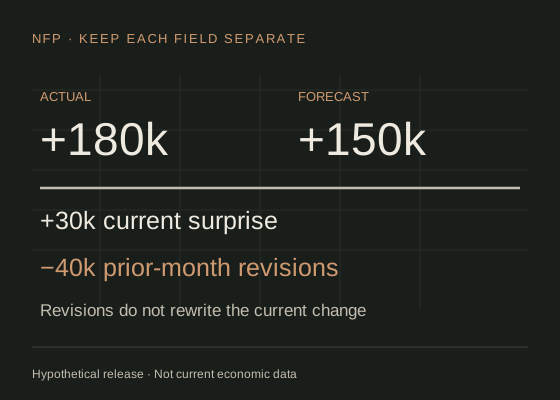
| Current payroll change | +150,000 forecast | +180,000 actual: +30,000 surprise |
| Previous two months | Earlier published estimates | Combined downward revision of 40,000 |
| Unemployment rate | 4.0% forecast | 4.1% actual |
| Average hourly earnings, monthly | +0.3% forecast | +0.2% actual |
The current payroll number is above this forecast, but the other rows complicate a one-word “strong” interpretation. The earlier revisions change the historical path; they do not redefine the current month's payroll change as 140,000. Keep the current surprise and revision total as separate fields.
The unemployment-rate surprise is 0.1 percentage point. That is different from saying unemployment rose by 0.1% in relative terms. The earnings row is a monthly percentage change, not a wage level.
These observations can inform a scenario discussion about growth and policy expectations. They cannot identify the next EUR/USD or gold candle without considering what was already priced and how participants respond.
Why revisions matter.
Payroll estimates can be revised as additional information arrives, with routine updates to the preceding months and a separate benchmark process. BLS: Current Employment Statistics and revisions provides current methodology and revision materials. A revision is not automatically evidence that the original publication was improperly prepared.
For a release study, preserve the initially reported actual, the contemporaneous forecast, and each revised previous value with timestamps. Replacing the original release with the final revised series gives a historical trader information that was unavailable at the time.
A useful journal compares the immediate reaction with a later observation using fixed intervals. For example, record the spread and bid/ask prices immediately before publication, then at one minute and fifteen minutes afterwards. Specify that schedule in advance and include uneventful releases too.
News interpretation and order execution are separate.
Even a correct macroeconomic interpretation can produce a poor trade if the entry occurs after a large move, the spread widens or the market reverses. A chart's visible level does not guarantee a fill at that level. Stops can slip; limit orders can fail to fill.
A beginner preparation exercise can be entirely observational: identify the release, write scenarios, record the data and review how the quotes changed without entering a position. There is no requirement to trade an event just because it is marked high impact.
If a study includes trades, predefine the allowed window, cost assumptions, order handling and a skip condition when quotes or connectivity are unreliable. Compare that process with normal-session conditions in the forex sessions guide.
Common NFP questions.
Does a higher NFP number always strengthen the dollar?
No. Markets respond to expectations, revisions, related data, positioning and changing policy interpretations. A simple sign rule ignores those inputs.
Is NFP released on the first Friday every month?
That is a common pattern, not a substitute for checking the official schedule. Holidays and other changes can alter publication dates.
Are NFP and the unemployment rate the same survey?
No. Payroll jobs and the unemployment rate come from different surveys with different concepts and coverage. Read them together without treating them as interchangeable.
Sources & assumptions.
Prepared by InsomniCapital; see our editorial approach. Sources checked on 2 October 2026. Schematics and hypothetical calculations are labelled educational illustrations. Historical observations identify their source, dates and method separately. Neither is a live quote, trade recommendation or reported trading result.
- BLS: Employment Situation methodology and surveys.
- BLS: Current Employment Statistics and revisions.
- BLS: official release schedule for 2026.
Educational information only, not personalised investment advice. Leveraged trading carries a high risk of loss. Read our risk disclosure. InsomniCapital has an Axi affiliate relationship and may receive compensation for qualifying referrals. References are not endorsements of this guide.
Lesson 26 checkpoint
Put the reading into practice
Work it through
Write a mock release with +180,000 actual payrolls, +150,000 forecast and −40,000 combined prior revisions. Keep the current surprise and revisions in separate fields.
Completion records your study of this lesson. Read the evidence standards for how examples and claims are presented.